Pianist Eunbi Kim on Memory, Dreams, and Identity
In the expansive soundworld of contemporary classical music, pianist Eunbi Kim’s sonic memoir “it feels like a dream” emerges at the intersection of family, identity, and childhood. Blurring the boundaries between recital and narrative, the program weaves together music, technology, and visual art, creating a space for listeners to tap into their own memories of the past, and dreams for the future.
The program, which will be making its National Sawdust debut on March 31, includes works by Daniel Bernard Roumain (DBR), Angélica Negrón, Pauchi Sasaki, and Sophia Jani for piano, pre-recorded voices, and electronics written for and performed by Eunbi, with projected visuals by new media artist Xuan. The evening will open with the world premiere of “Nachimban (나침반),” a new work by Pauchi Sasaki written for Eunbi, and also features music by Zosha Di Castri. Her album, It Feels Like (2022), debuted at No. 2 on the Billboard Classical Albums Chart.
My first encounter with “it feels like a dream” was also the first time I met Eunbi—at a talk for early-career musicians like myself on the process of pursuing creative projects. I later had the privilege of becoming one of her mentees through her organization, bespoken, a mentorship organization empowering women and non-binary musicians in classical, contemporary, and jazz fields.
Conducting this interview with Eunbi during my time as A4’s Anjeli Jana Memorial Intern was a full circle moment. Ahead of her upcoming performance at National Sawdust, we spoke over Zoom to take a closer look into her creative processes, sources of inspiration, how she balances her identities as an artist and mother, and more.
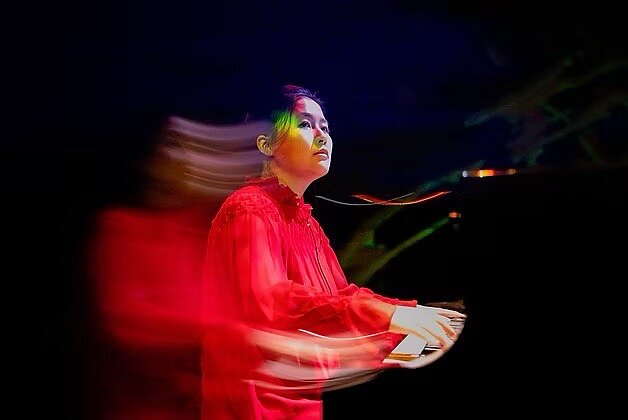


Eunbi Kim: When I had the idea for this performance, I was four months postpartum. I wanted to express what was happening: everything felt like a dream, somewhere between reality and imagination. Even in the most practical sense, like not knowing what day or time it was, whether I was awake or dreaming. Everything felt so surreal around this time. It was a tremendous life change and felt like a shock to the system.
The title also alludes to dreams of my parents that were on my mind around this time, and also the dreams I have for both of my children. I kept it abstract for a reason because, although the title was inspired by my own personal experiences, I prefer that the audience come away from it with their own interpretation.
EK: It’s a mix of different people through the years. Daniel and I have a longstanding friendship. He was the first composer I worked with back in 2014 or 2015. Among this group, he’s my oldest friend and he’s also a wonderful mentor.
I met Pauchi during the pandemic, through bespoken, because we were hosting an online series with International Contemporary Ensemble on the intersection of technology and art. I really enjoyed speaking with her and listening to her music. I approached her to write a piece after that and we became very good friends and colleagues through that process. I’ll be premiering one of her newest pieces at this show.
Angélica and I were on the same program for a concert at New Music Gathering with Pamela Z. We had talked about doing something together for a number of years after that and were finally able to for my last album. That’s the piece I’m performing.
All the collaborators I’ve had come from a connection I feel with them, both as an artist and as a person. Sophia is definitely one of those people who I really connected with in different ways. I met her a couple years ago at Bang on a Can Summer Institute. I also collaborated with her during the pandemic.
Zosha and I met through Matricalis, which is an organization for musicians and mothers. She’s one of the co-founders of that organization, and I heard one of her pieces at their conference called “The Dream Feed” and I wanted to program it.
I feel like I’ve known Xuan forever. I actually cannot remember how I met her. When we were in residence together at the Baryshnikov Arts Center, she created all the visuals and projections and directed this program.
EK: The first funding I received that I used for commissioning was from Korean Cultural Center New York—they’ve been unbelievably supportive, and I used that funding towards the piece by DBR. Everybody’s process is a little bit different when it comes to commissioning and it’s different between an individual artist versus an ensemble or an institution.
I think a lot about who I want to commission, who I want to work with. Usually it’s somebody I find a very deep connection with and feel comfortable with because the process involves a lot of sharing and conversations and working together.
For this particular project, Daniel had written this piece “It Feels Like a Mountain, Chasing Me,” and I used that piece as the foundation. The second person I commissioned was Angélica, who listened to Daniel’s piece and built upon that. Sophia was next and listened to what was already there and built on top of the existing music.
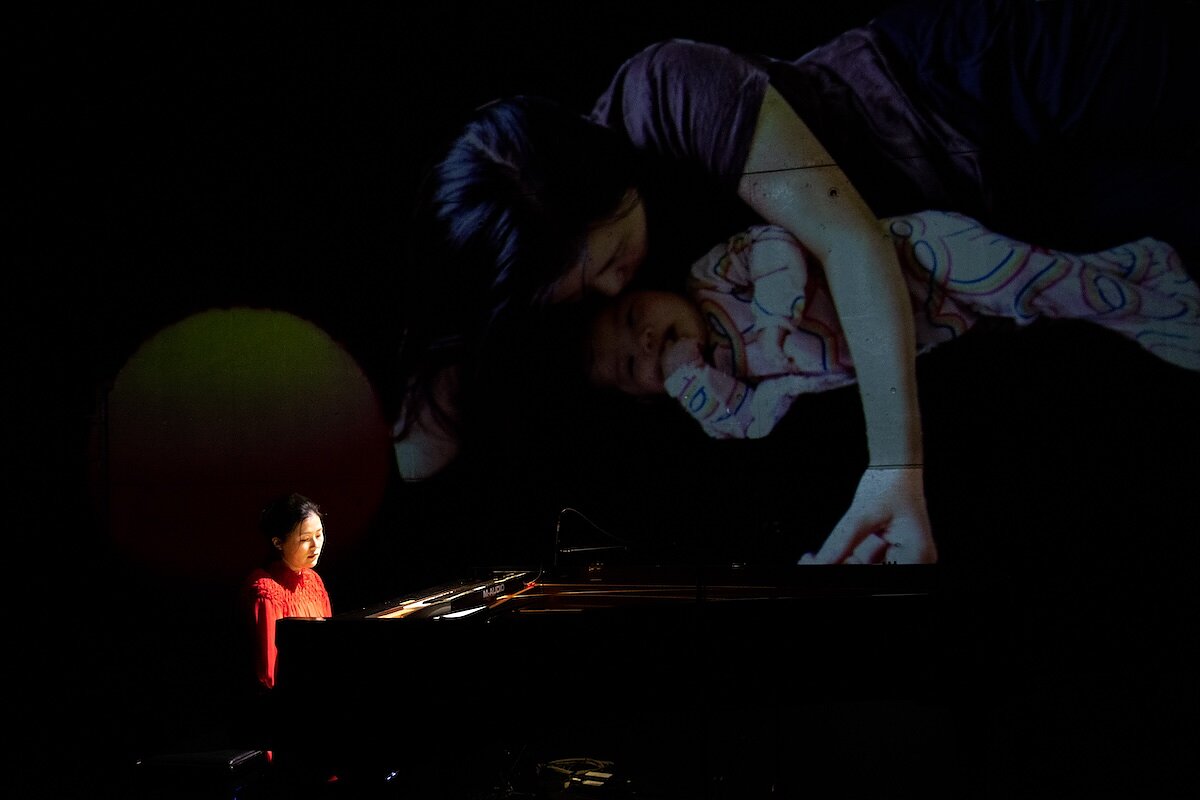
That collaborative process is super important. Because we are using a lot of personal archives like home videos and conversations, I had to figure out what I felt comfortable sharing. I don’t always know what my limits are, sometimes I’m surprised by what I’m willing to share, but then I also discover that there are things I don’t feel comfortable with.
EK: I believe pretty strongly that encouragement can go a long way, especially for young artists. The way I view mentorship is not hierarchical. When I look back, what had the most impact for me was having mentors who really encouraged me, supported me, gave me advice, and were present. They would show up to different things I was doing and let me know if I was on the right track with something. That can really sustain a person’s practice moving forward, and create a lot of momentum in somebody’s career.
I think of bespoken as creating a space and community for people who are doing really interesting things in music to meet each other and be peer mentors. I think it’s important to have access to something like this that isn’t affiliated with school.
Some of my biggest mentors were people I met towards the end of grad school and shortly after, in the early years of trying to start my career—people like Angela Beeching, Anthony De Mare, Jade Simmons, Lisa Yui, and more recently, Rosemary Caviglia. They gave me critical feedback that I was able to trust but more importantly, they were encouraging in such a vulnerable time of my life to try something new.
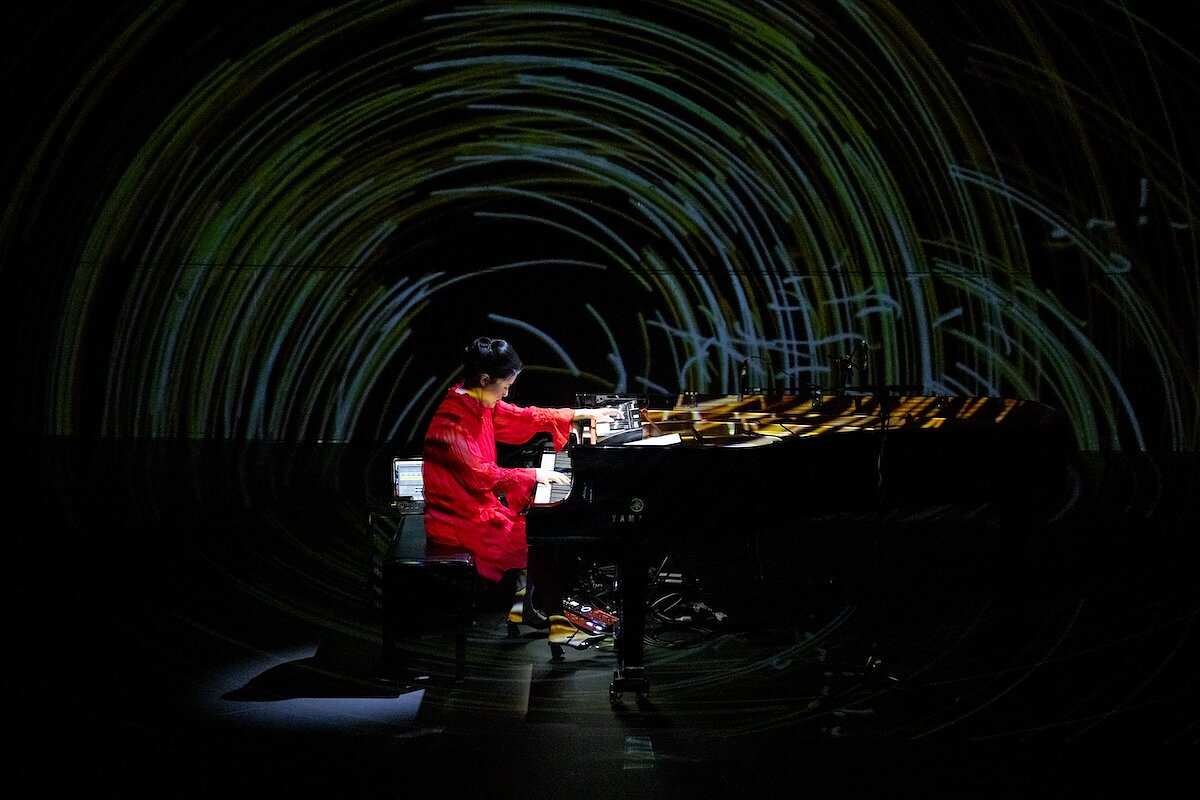
EK: This piece “Nachimban (나침반)” by Pauchi was inspired by my search into my family’s history and the feeling of loss. As a child of immigrants, I was cut off from any family members outside of my immediate family. My grandparents passed away last year, but I never had the chance to know them. I’ve definitely felt at many points in my life this void of not knowing my family history, not even knowing what even brought my parents to the US.
I think a lot of people can relate to these smaller ripple effects of immigration on future generations. I’m not saying it’s good or bad—just an aspect of this experience that doesn’t get as much exposure.
EK: I actually had a very recent creative block that lasted for a pretty long time. It started right after doing a series of performances of “it feels like a dream.” What helped was revisiting old material, reading old journals, writing, looking at some notebooks of different ideas that I may have had in the past. Reading helps. Reading has always been my main source of inspiration.
I read this book called How To Love by the Buddhist Zen master, Thich Nhat Hanh. It inspired me to put together this recital while I was an Artist Fellow at the National Arts Club called “How to Love”. I wanted to try something smaller scale which was also helpful with getting out of a creative block. I felt a lot of pressure to put on another large project but I realized not everything has to be a big, fixed idea.
I also love going to art museums. That’s always a big family event. The recent Ruth Asawa show at MoMA was really inspiring. I also love listening to a lot of different music.
EK: This new piece by Pauchi is part of my next project which is based around the theme of time. It explores how the past and the future inform the present, thinking about time as non-linear.
I’m really excited about some of the new works that are being written. One of them is by Corey Chang. “The Dreamers” is based on poetry that my dad published over 30 years ago. I had always known that he had published poetry, but I had never actually had the chance to read it until recently. I worked with a translator to translate the poems, and it was such a fascinating discovery for me to read my dad’s poetry that he wrote right around the time he immigrated. I got to know the kind of person he was and realized how much immigration really impacted him and how traumatic that experience was. This project and “it feels like a dream” have similar themes and inspirations but this new one is more explicitly about family history and the passage of time.