Alison Nguyen on Preserving Cultural Memory
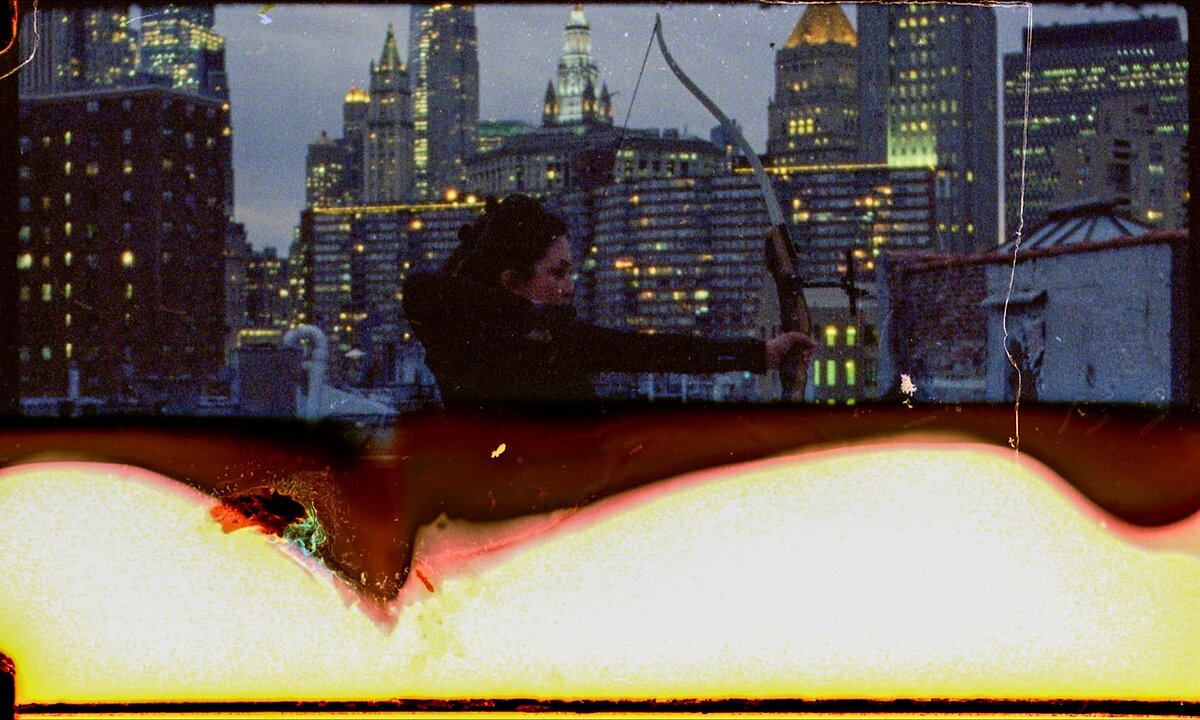
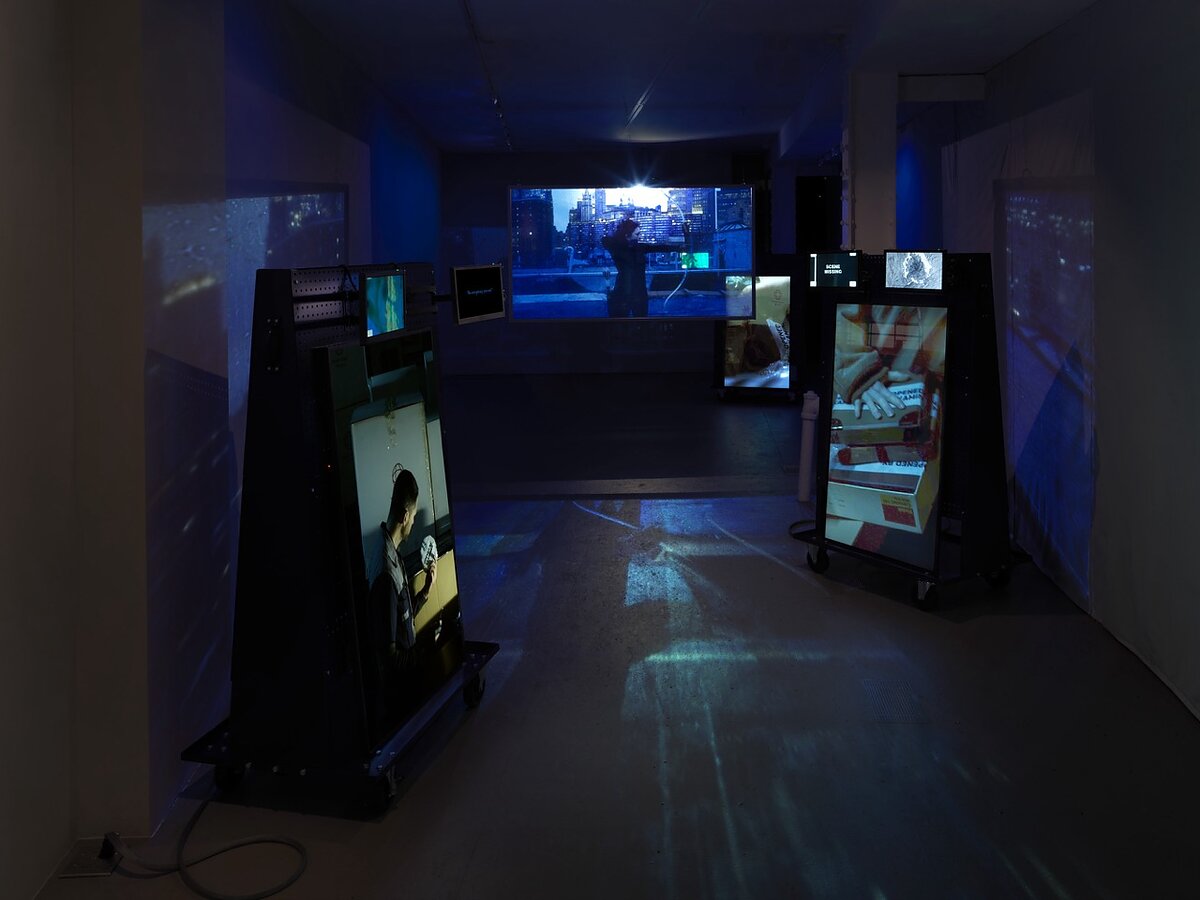
What does the preservation of cultural memory look like under oppressive regimes? Artist Alison Nguyen explores this question in her exhibition “Perforation, Ellipse” at Storefront for Art and Architecture. At the center of the show is projected footage of Nguyen shooting an arrow from a NYC rooftop. Smaller screens dispersed through the gallery show her speculative fiction short film, Aisle 9 (2025), along with archival footage of people covering Vietnamese Bolero music.
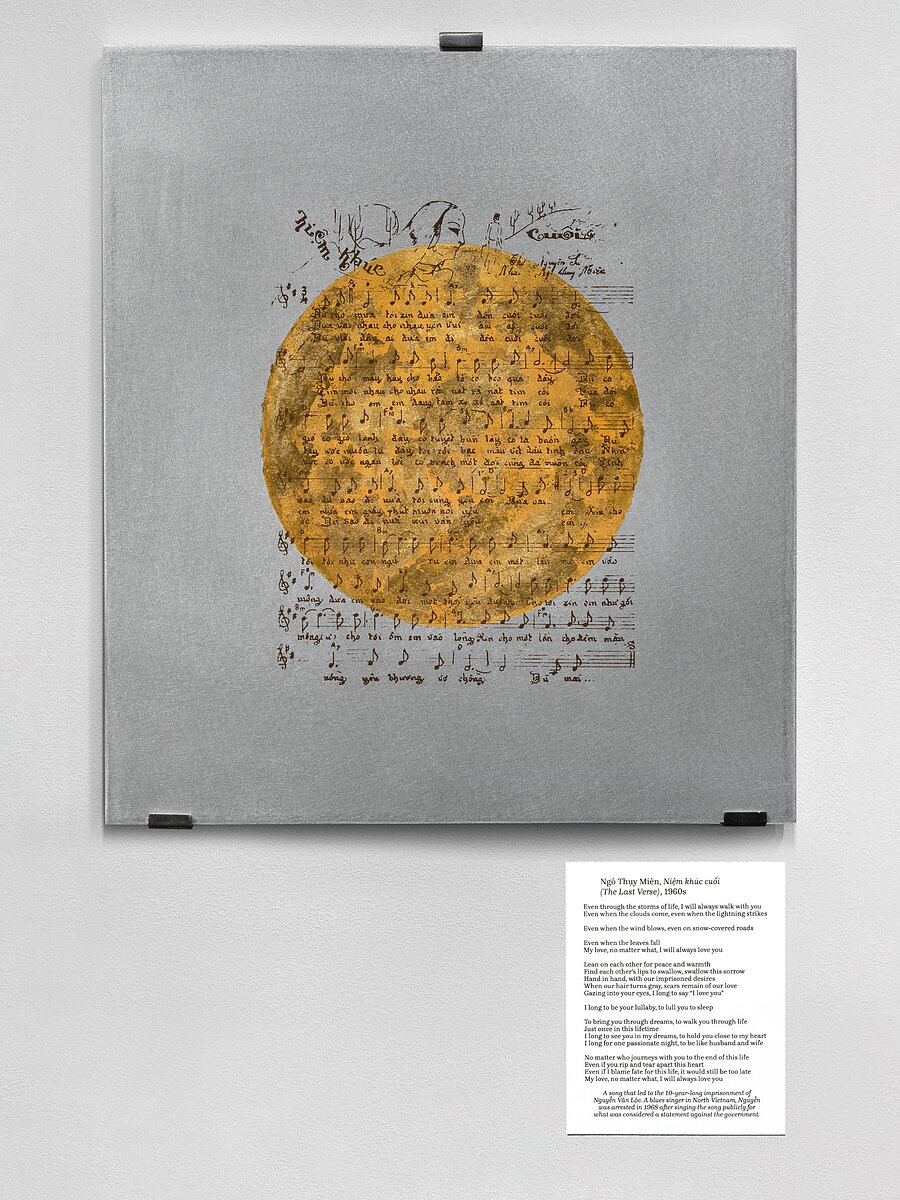
Also referred to as “yellow music”, Bolero was banned in Vietnam following the fall of Saigon in 1975 and later revived in the ‘90s, with covers upon covers sung by Vietnamese elders over the years. This soundtrack plays as we follow a group of factory workers in the not-so-distant future who make an unexpected discovery. Along the gallery walls are canvases featuring Bolero sheet music rendered in gold leaf and metal. As a whole, the exhibit grounds visitors in a multidimensional reality, where Vietnam’s nearly lost art scores a dystopian mirror into the present and future of a surveillance state.
Nguyen’s show is part of a larger series at Storefront for Art and Architecture titled “Homelands”, a long-term research project which delves into the politics of memory, and the ways in which dominant narratives can distort histories across the globe. I spoke to Nguyen about her cinematic impulses, developing a multimedia experience in an untraditional space, Vietnamese Bolero, and the seasonal relevance of the exhibit.
Alison Nguyen: “Perforation, Ellipse” encapsulates my thinking through and experimentation with various constructs of time, realized over a six or seven month period. My research spanned elements of philosophy, cultural history, and most immediately the moving image. Cinema as a form is interesting in that it conveys a temporal paradox: Motion and continuity are conveyed through a succession of still frames. I’m drawn to the unstable, fugitive cinematic image and the medium’s temporal instability. What a perfect form to work with in exploring and potentially problematizing time-space relationships.
I wanted to understand time quite physically so I went back to my roots as a filmmaker and began to work with 16mm film, directly animating it and also creating mediated performances with it. The score, or structure, of the 10-channel looped video in “Perforation, Ellipse” is based on my durational performance deliberately lasting for one 400 ft roll of 16mm film, or 11 minutes. In the filmed performance I shoot a bow and arrow on a rooftop in Chinatown. The target is out of frame, but you can hear the sound of the arrows hitting it. I used this very particular sound as a way to structure the edit. The sound of the arrow initiates cuts or shifts in the material of the edit. The piece evolved from there.


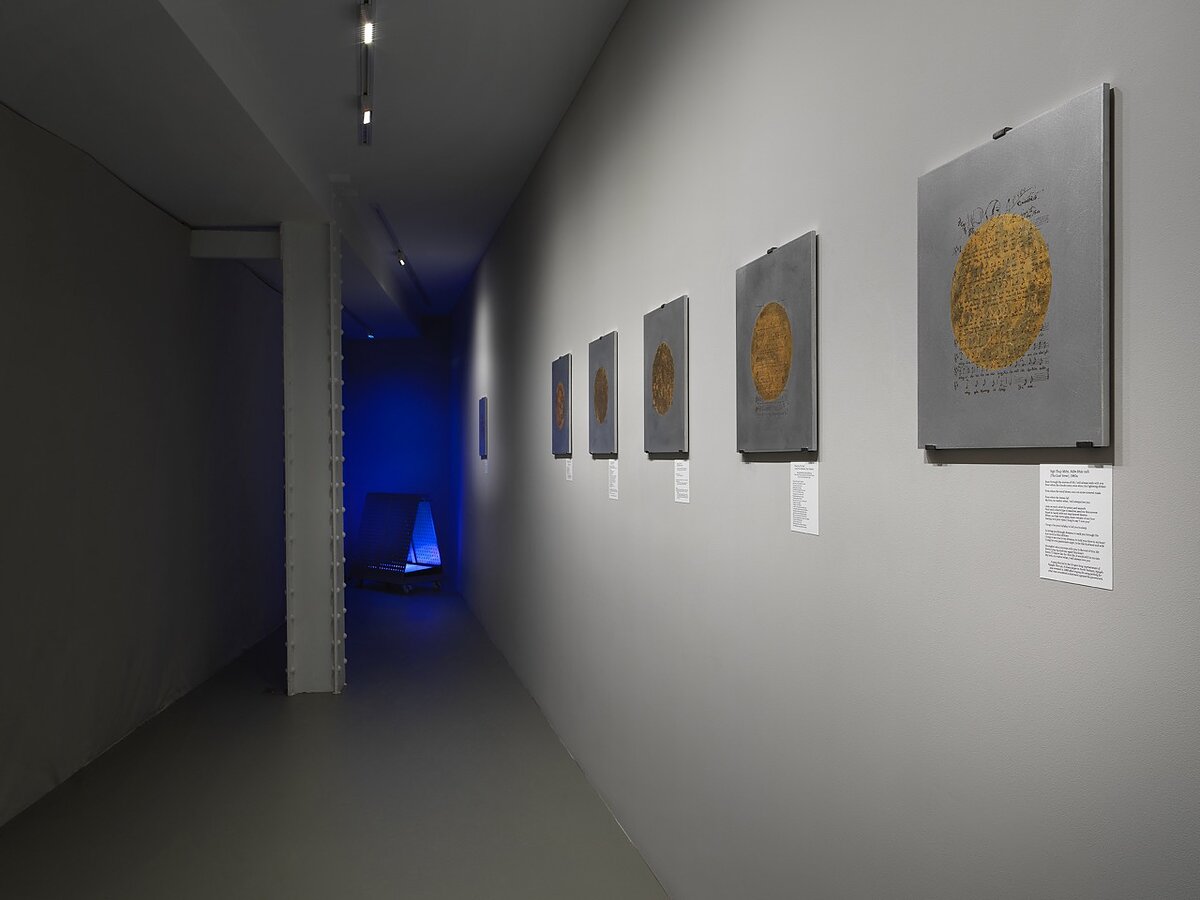
AN: I most likely first encountered Bolero music without knowing what the genre was called when I was younger. I have translucent, ambient recollections of it playing in Vietnamese restaurants I frequented growing up. In 2024 during the research process for my film Aisle 9, I was looking into instances of past cultural censorship—in particular that of music—and my brother Matthew sent me a link to article about Nguyễn Văn Lộc, a North Vietnamese singer, who was imprisoned for 10 years beginning in 1968. His arrest had to do with his performance of sentimental love songs like “Niệm Khúc Cuối” (The Last Song). Bolero music, which often focuses on suffering, love, and peace, was seen in opposition to socialist cultural standards.
From a distance, the banning of love songs seemed so absurd that I felt that I needed to incorporate this element of the real into my speculative fiction work. I’ve always maintained that reality is much more fantastical and strange than anything I could possibly imagine. It’s a starting place for much of my work. I’m interested in going so far into the real that you reach fiction and pushing fiction so far that you create a documentary.
AN: This past December and January I was editing the installation in my studio, at the time in Red Hook, a corner of Brooklyn which feels particularly vulnerable to the wintry elements in its isolation and proximity to the water. I didn’t feel like I was in New York City.
In the editing process I was simultaneously narrowing down the modern covers of Vietnamese Bolero music I had found by others performed online. Many of the videos I was drawn to and gained permission to use were of songs that contained lyrics about summer, a lost love, and often a broader meditation on human mortality.
The conflation of the fragments of snowy scenes in some of my more narrative installation footage combined with these performances and their lyrics fading in and out of the vertical screens was compelling to me.
Being “out of sync” is a large part of the underlying philosophy of this body of work. It’s not something that I bemoan but rather set into motion in the installation, using it as a guiding logic within the work.
AN: On a literal level, I hope gallery visitors take a newsprint that Storefront produced. Curator Jessica Kwok and I put a lot of thought into including texts that frame the work, such as Silvia Federici’s “In Praise of Conspiracy Theory” (1985) which runs throughout the installation, Lukas Brasiskas’ new essay on time and cinema, and an excerpt from Pope. L’s “Hole Theory” (2002), among others.
I also include a scanned film leader with holes punched in it, an artifact from Japanese conceptual artist Takahiko Iimura’s expanded cinema performance “Circle and Square” (2017). Takahiko and his partner Aikiko were friends [of mine]. Earlier in my career, they introduced me to artists within New York’s experimental film community who helped me develop my early work, screened it, and took care of it. It’s a nod to this lineage of downtown New York artists who shaped both Storefront for Art and Architecture and had an influence on my own practice.
Alison Nguyen’s “Perforation: Ellipse” is on view at the Storefront for Art and Architecture until March 28th.
—Bri Ng Schwartz is a culture writer and arts administrator based in Brooklyn. She is the Education & Community Outreach Manager at Primary Stages and Features Editor at LADYGUNN. She is a contributing writer at JoySauce, Mixed Asian Media and Off The Record Press and has written for publications including HowlRound and American Theater Magazine.