Tomokazu Matsuyama on Celebrating the Diversity of New York City
In the world of Japanese American artist Tomokazu Matsuyama, figures in richly patterned attire exist in candy-coated and saturated psychedelic hues. They ride horseback through fantastical landscapes or sit in elaborately appointed interiors. These maximalist canvases reflect his trans-national, multicultural upbringing, mixing in references from Japanese manga to Renaissance art.
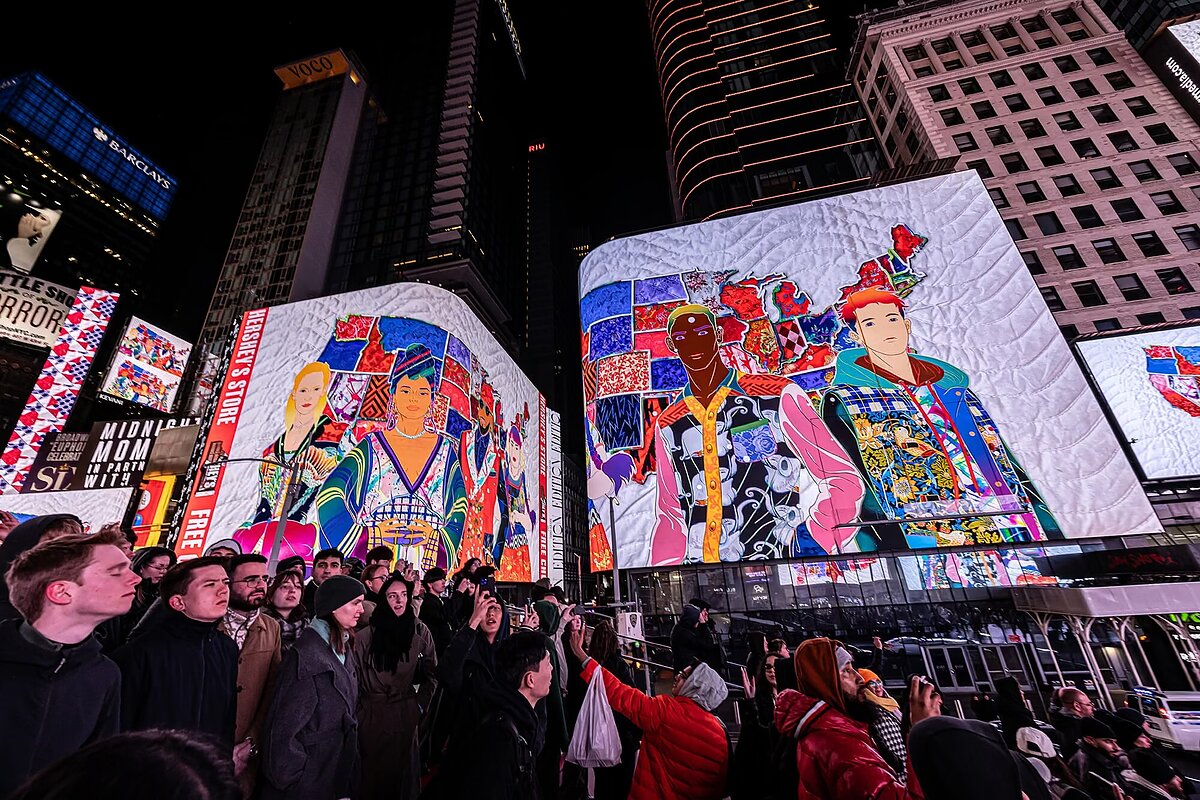
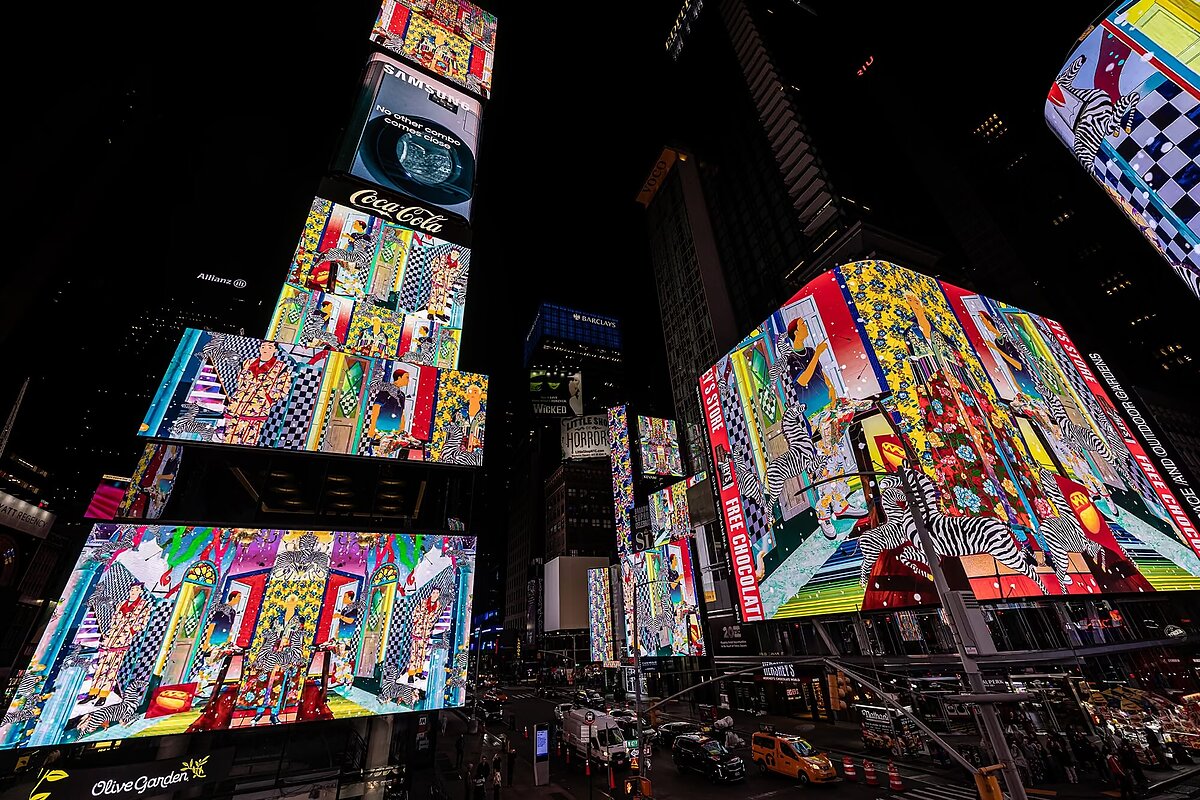
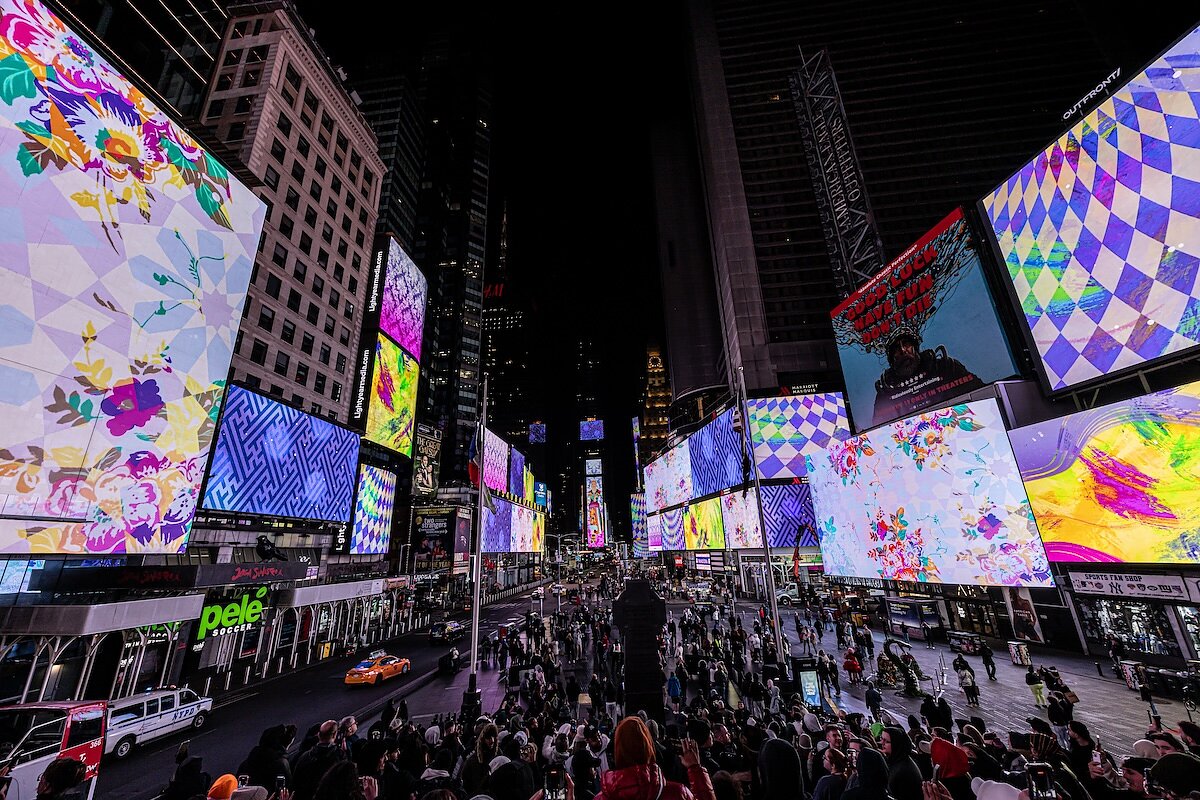
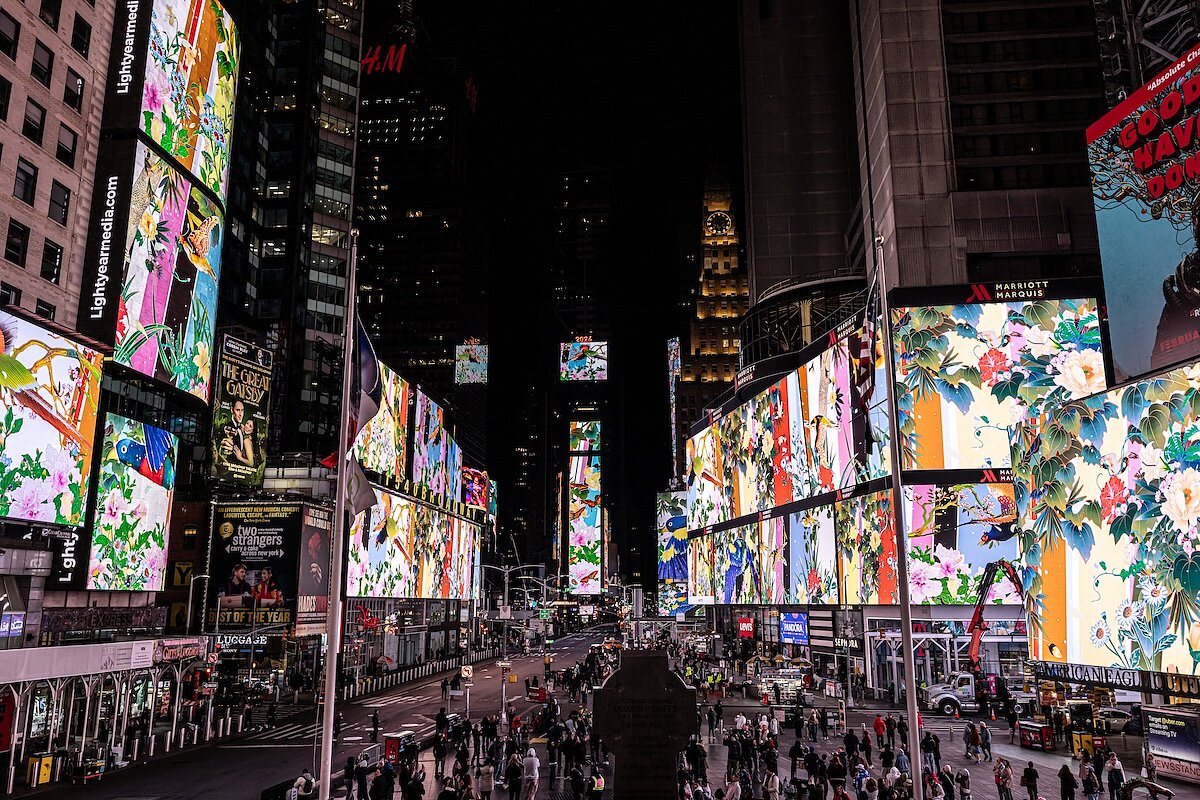
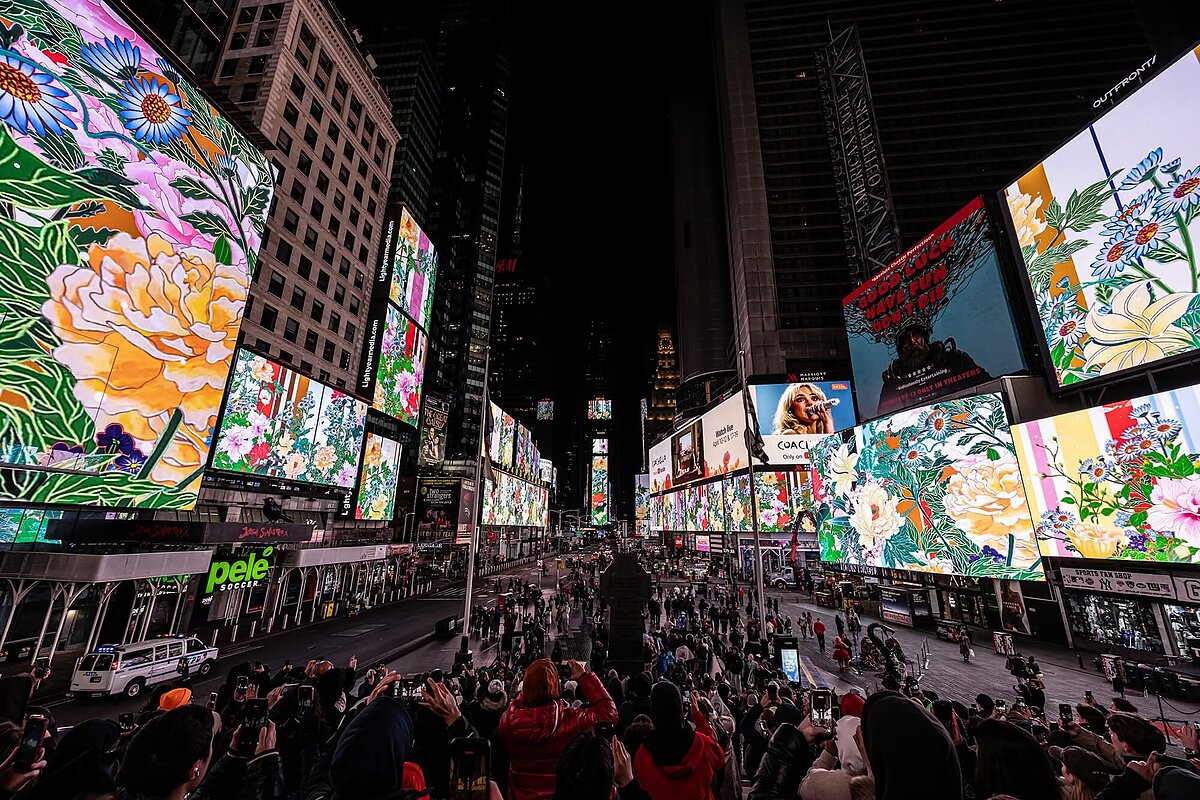
Matsuyama’s dramatic, intricately detailed paintings were recently translated into video for Times Square Arts’ Midnight Moment in Morning Again. Through April 30, the commission can be seen every midnight on the giant LED screens in Times Square. Though Matsuyama is no stranger to massive public art projects, having created large scale video projections throughout Asia and the US, Morning Again is his most ambitious in narrative scope and audience reach. Running across 96 screens, the piece focuses on the different currents that run through New York City that help make it resilient, diverse, and always transforming.
Despite Morning Again being shown in one of the most public places in the world, the work is also very intimate. Instead of the images being seen from a distance, lost in a sea of billboards, Morning Again surrounds viewers on screens closer to the ground, allowing us to see the richly detailed animation close up. The work encourages viewers to engage with the view, moving along with the piece; Matsuyama responded to this by carefully choreographing the images and music, engaging the viewer in a flowing narrative.
This theme of fluidity ripples throughout the artist’s decades-long practice. In The True Oasis Erase (2023), a figure stands in a landscape drawn from Classical Asian art wearing a hybrid of a tartan kilt and East Asian costumes. The gender of the figure, the clothing, the setting are all ambiguous, a deliberate attempt by the artist to platform a world in which we are all hybrids, which, for Matsuyama, encapsulates what this city is.
Ahead of the opening, I spoke to Matsuyama to discuss his Times Square Arts commission and his practice at large.


TM: Yes, that was on occasion of having an exhibition at the Long Museum in Chongqing. But I’ll be very transparent. [In Chongqing], the quality of the LED was the poorest I’ve ever worked with. But that doesn’t mean that it’s good or bad, just that when things are limited, there’s always a way to use that to amplify specific themes or specific messages. I learned from that experience how to approach this project. Times Square has the world’s best LED technology.
What’s unique about this project is the scale. Let’s say in Shanghai or Hong Kong, you tend to see it across an island or a river or with distance. But in New York City, it spans from the first floor of a building to maybe the seventh, eighth floor. So it’s the closest visible projection you can experience. And it also surrounds you, you’re actually becoming a part of it, which is very exciting.
TM: It will be more narrative-driven, but it won’t be a specific narrative; it will be utopian and abstracted. You’ll understand components that are very concrete and specific, but the message itself is not something you can instantly understand. New York welcomes diversity, independence, and being different. The beauty of this country is that we are open to discuss anything. For example, this weekend, everywhere across the country were No Kings rallies. People gathered to discuss what’s equal and what’s right in our own singular standard. Therefore, I didn’t want to criticize religion or politics or the way we see the world. It will focus on how different perceptions are married in New York City and welcome that.
[Times Square] is a very capitalistic place, an economical hub that is driven by tourism. But at the same time, it’s still very New York. You go there, you see fake Elmo, fake Mickey Mouse, and then you see a cowboy in his underwear. And although it’s commercial and cutesy, you see a slightly dark side of American culture. I like the messiness, the chaotic nature of that. Everybody is trying to brand themselves—that’s the beauty. There’s repetitive, nonstop ads everywhere.
What I did was start with a blank canvas, with no text, no imagery. From there I would start my narrative. I am from an electronic country, Japan. We made Toshiba, we made Sony. The thing I’ve seen some artists do in the past and didn’t want to do is stamp one animation throughout the entire display, making it look like an electronic store lined up with TV monitors. What I did instead was separate images that would flash on different screens. At certain times, it will all be unified. That’s the beauty of this project. You become the stadium and the artwork is watching you. You’re in the center of the field. I really enjoy how that happens in this program.
XC: Yes, that’s actually occurred in the past, in particular with Shahzia Sikander. When she had her Midnight Moments commission, there were some corporations that did not agree to her work and she was given less than the originally allotted number of screens as a result.
You have done public sculpture projects in the past. Will there be a sculptural component?
TM: I am heavily influenced by ‘90s culture. That’s my generation. It was before social media. It started with cassettes and moved to mini discs and CDs, then finally to iPods. I went from analog to digital. I also look at other forms of expression, like music. DJs have become prominent creators and always bringing something innovative and new to the table. Or fashion. There are [creative voices] that are influencing big houses like Dior or Louis Vuitton, where now they are also making sneakers. Younger voices are becoming a major part of traditional culture.
People have long borrowed from the past and remixed them into something new. I don’t want to speak on the Asian diasporic experience but coming to New York as an Asian and a self-taught painter without real academic training, I thought that I could become a voice. My father was a pastor and I grew up in a Christian community but I was drawn to New York downtown culture and the culture of the city as a whole. It was all about the energy, the positivity of that. I wanted to take that and [do my own remixing]. I wanted bring traditional painting from China, from Japan, fold in consumer culture, Christian iconography, and neo-classical painting from France. I wanted to bridge all that. I wanted to be a global citizen that happened to be Japanese.
TM: For me, it was the work I made for Shinjuku Station in Tokyo. It’s one of the biggest metro stations in the world, with over 3 million passengers passing through it every day. The laws in Japan are very strict and can be quite conservative when it comes to a project that has no precedent but Japan Rail and Lumine (a tenant of Japan Rail) trusted my idea of bringing in an eight-meter sculpture in the recreation area and pushed for this project to go through.
None of the Japanese foundries ever made anything to scale so I had to work with an American Foundry, which was Urban Art Projects (UAP). However, the structural engineer in Japan would not accept the proposal; it was not written in Japanese. We then had to hire somebody to do the drawings with the Japanese foundry to then be sent to UAP. So the structural drawing was in both English and Japanese. When UAP started production, we had to have meetings through Zoom with the Japanese foundry to make sure it all lined up with the drawings. We did this for three months with a 13 hour time difference! But we really had a belief in this project. We wanted it to represent the local community, the past and its future. It was a really challenging experience and helped me gain much needed experience when working on future public projects.
Tomokazu Matsuyama’s Morning Again is on view at midnight at Times Square through April 30.
—Xhingyu Chen is a published author and independent art critic. Her book, Museum in Transit: 10 Contemporary Artists in the NYC Subway, will be released June 28th 2026 by Schiffer Publishing. She lives in Brooklyn, New York.