“Feeding the Load” Confronts the Body’s Long History of Being Shaped
To be alive is to undergo an endless process of adaptation. This process can unfold across scales, from environmental collapse and species response, to the body’s gradual pathologization, to the survival pressures imposed by patriarchy, colonial restructuring, and migrant life.
“Feeding the Load, Regulated Dosage” curated by Rui Jiang at Frisson Gallery (on view through April 4, 2026) brings these threads together through a shared language of body horror. Artists Echo Youyi Yan and Cass Yao trace the entanglement of biological, historical, and political forces, exposing how systems of control operate through and upon the body. Their works suggest that adaptation is never neutral, but a violent negotiation, where the body either submits or rots in refusal.
The exhibition carries a strong visual unity, anchored in the spine as a formal and conceptual language. This shared motif produces a sense of verticality, as if each piece is oriented by an invisible axis that pulls the body upright, imposing a quiet authority that demands compliance.
“The spine was a key thread I wanted to foreground from the very beginning,” curator Rui Jiang said. “Coincidentally, Frisson Gallery’s logo is also a cross section of a spine.”
To deepen this dialogue, Jiang introduced a flexible fence made of wooden planks and wire mesh as a curatorial device within the exhibition space. Titled You May Touch the Fence (2025) and made by Yan, the structure winds through the gallery like the skeleton of a brachiosaurus, subtly choreographing how viewers navigate and inhabit the space.
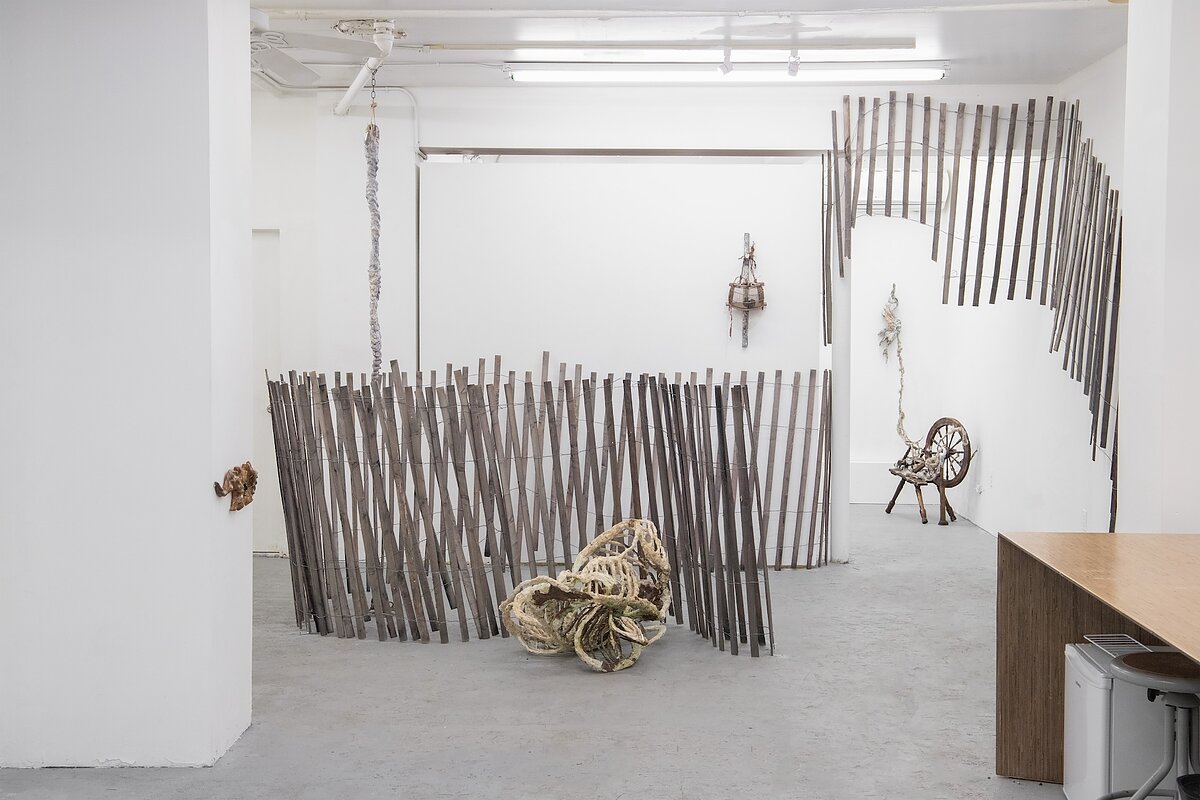


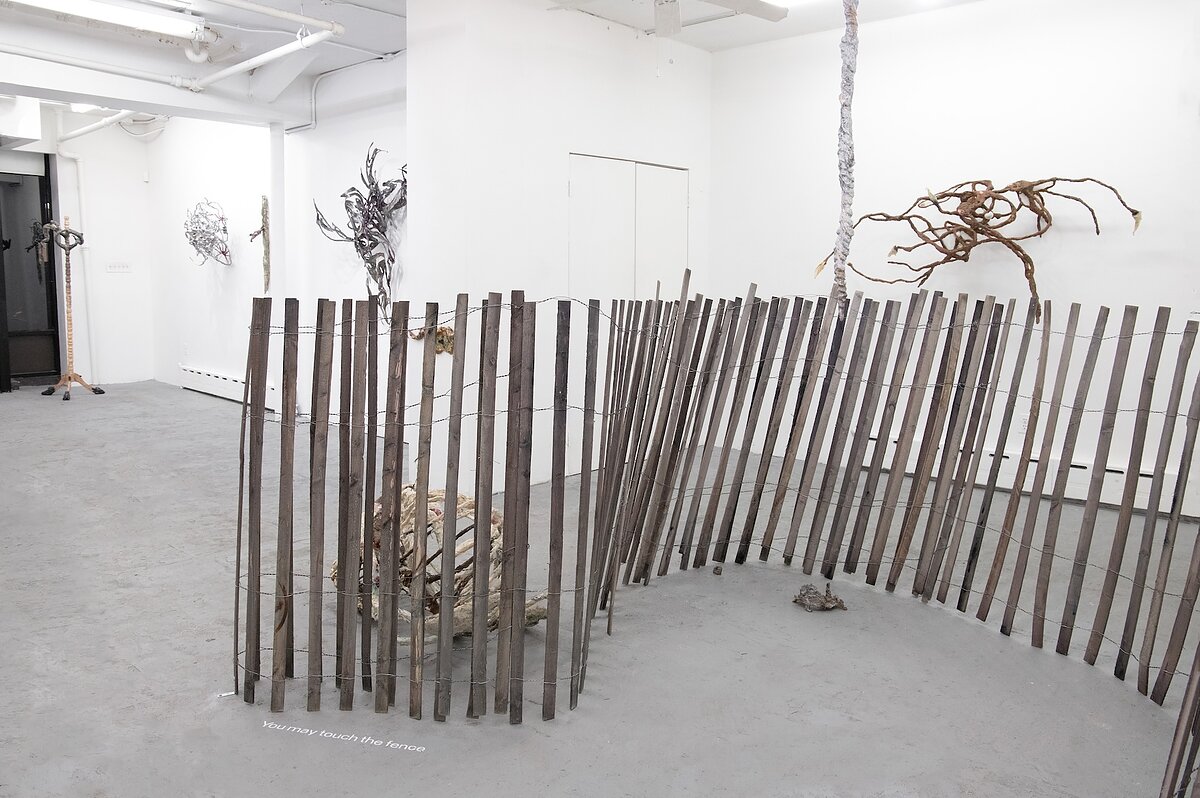
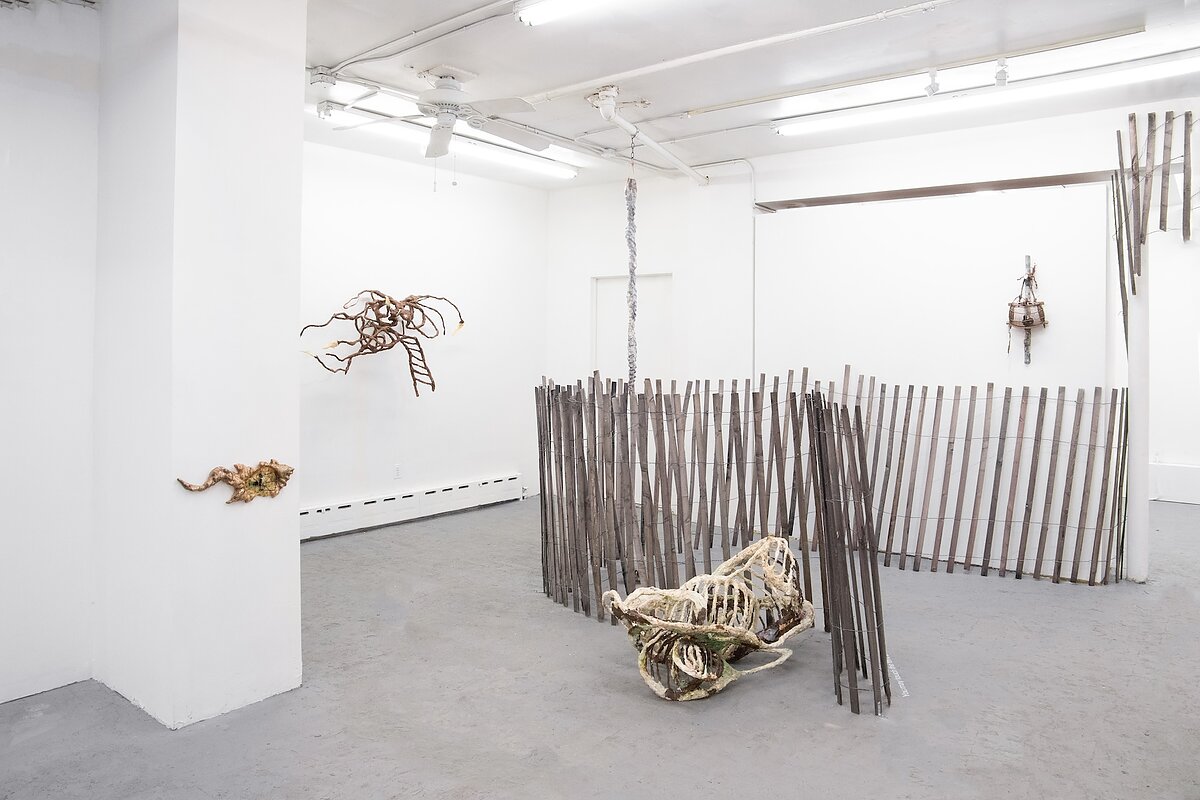
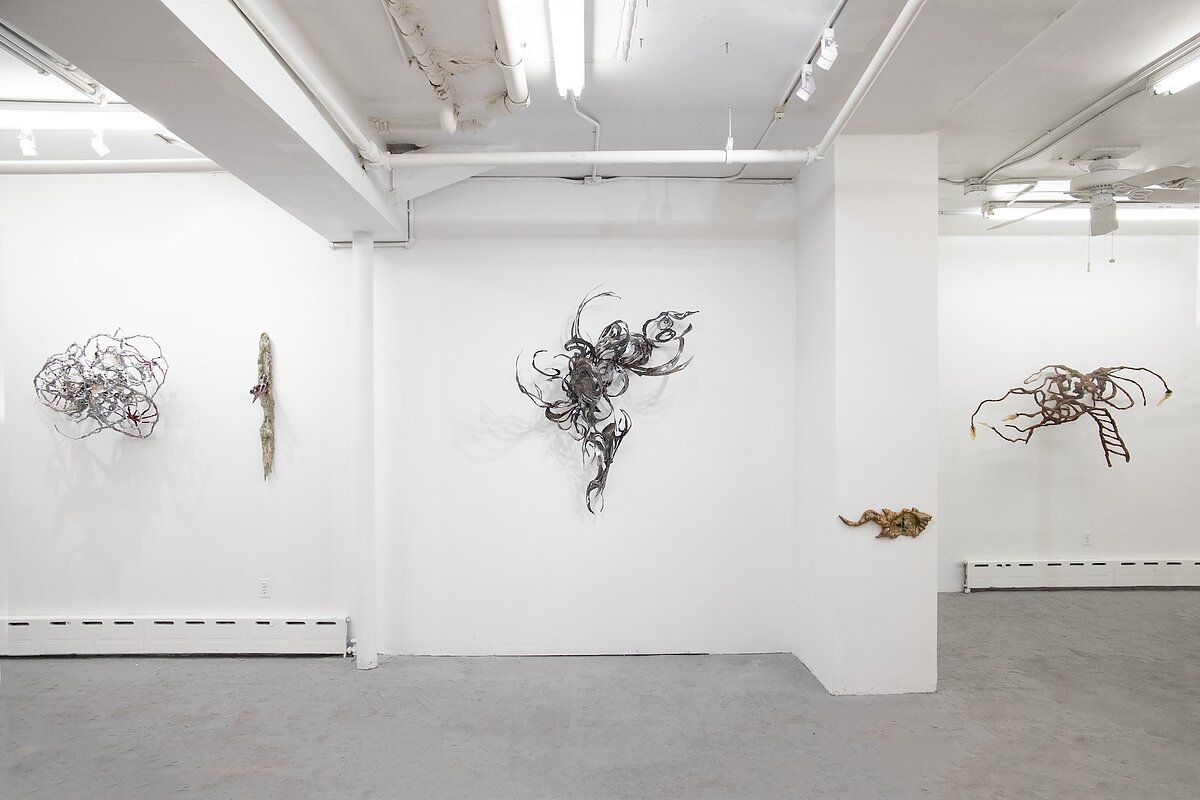
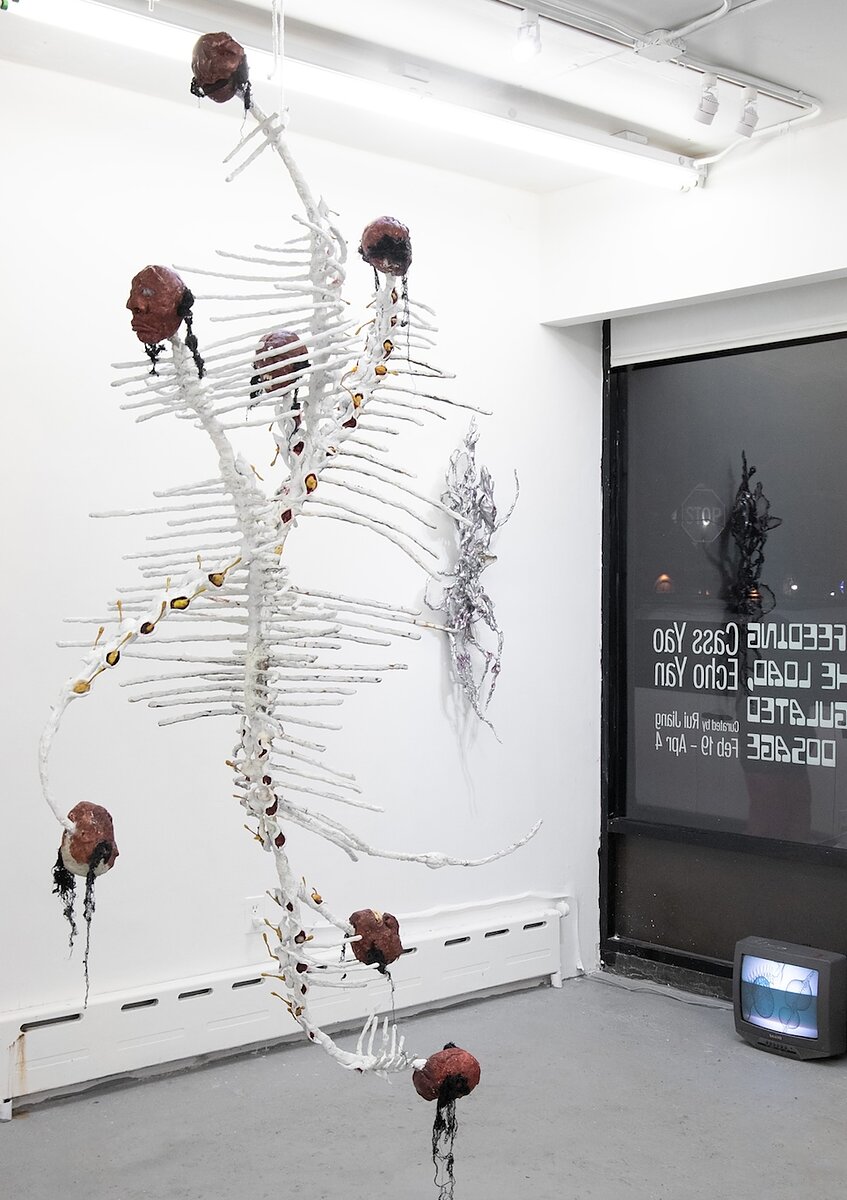
For both artists, the recurring attention to the spine emerges both as metaphor and from lived experiences of illness and pain. Yao approaches the spine as a carrier of organs, hormones, and mutation. Upon entering the gallery, viewers encounter Axis (2025), a suspended skeletal structure that resists any simple vertical reading. Its tangled and proliferating bones dissolve distinctions between up and down, front and back, extending outward into space.
From its joints hang seven shrunken heads fitted with false teeth and hair, evoking both the skull garlands of wrathful bodhisattvas in Tibetan Buddhism, which symbolize interchangeable identity, and Thomas Moynihan’s Spinal Catastrophism: A Secret History, a book that frames the spine as a mediator between human consciousness and the deep time of the earth.
Distributed across the gallery’s side walls, the Anatomy series (2025) extends this thinking further. Here, Yao reimagines the human nervous system through the modular, segmented structural logic of the worm, proposing a kind of cross-species morphogenesis. The resulting sculptures, assembled from complex and heterogeneous materials, are strikingly abstract, radiating a quality that feels at once post-human and extraterrestrial.
Conversely, Yan begins from an intimate discomfort with her own spine. Her sculptures investigate the domestication of the body by fusing spinal forms with furniture and tools associated with feminized labor.
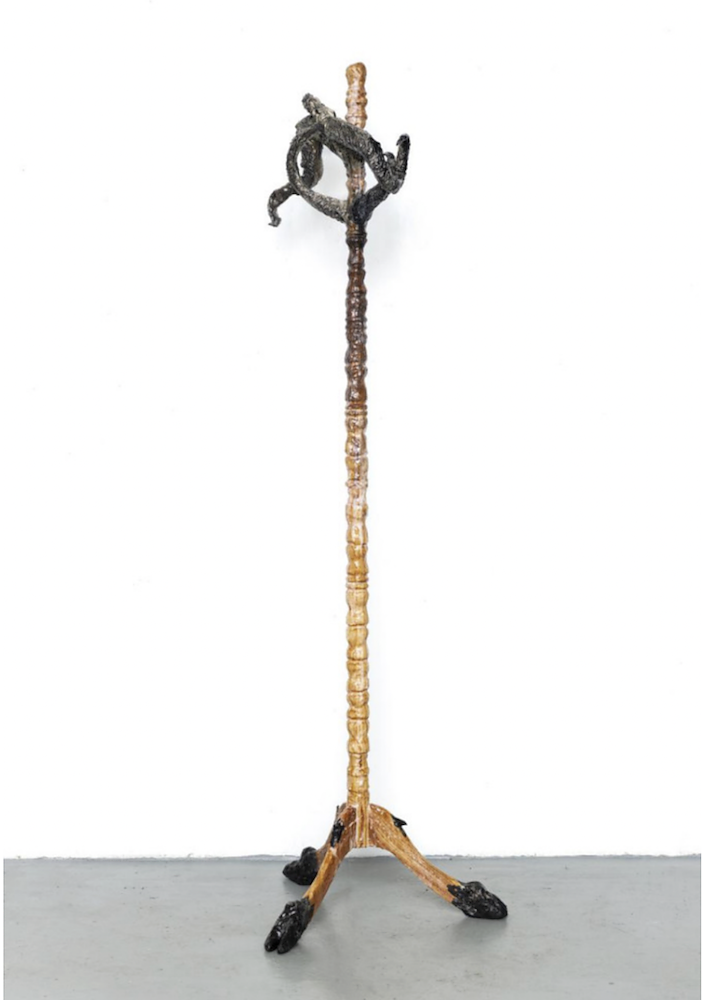
In Weresheep (2025), what first appears to be a standing coat rack reveals itself as something more unsettling. The hooks take the form of sheep horns, the central pole carries the texture of a spine, and the three supporting legs resemble both animal hooves and slippered human feet. The work collapses distinctions between human, domesticated animal, and object, suggesting a condition in which bodies are trained, instrumentalized, and fixed into place.
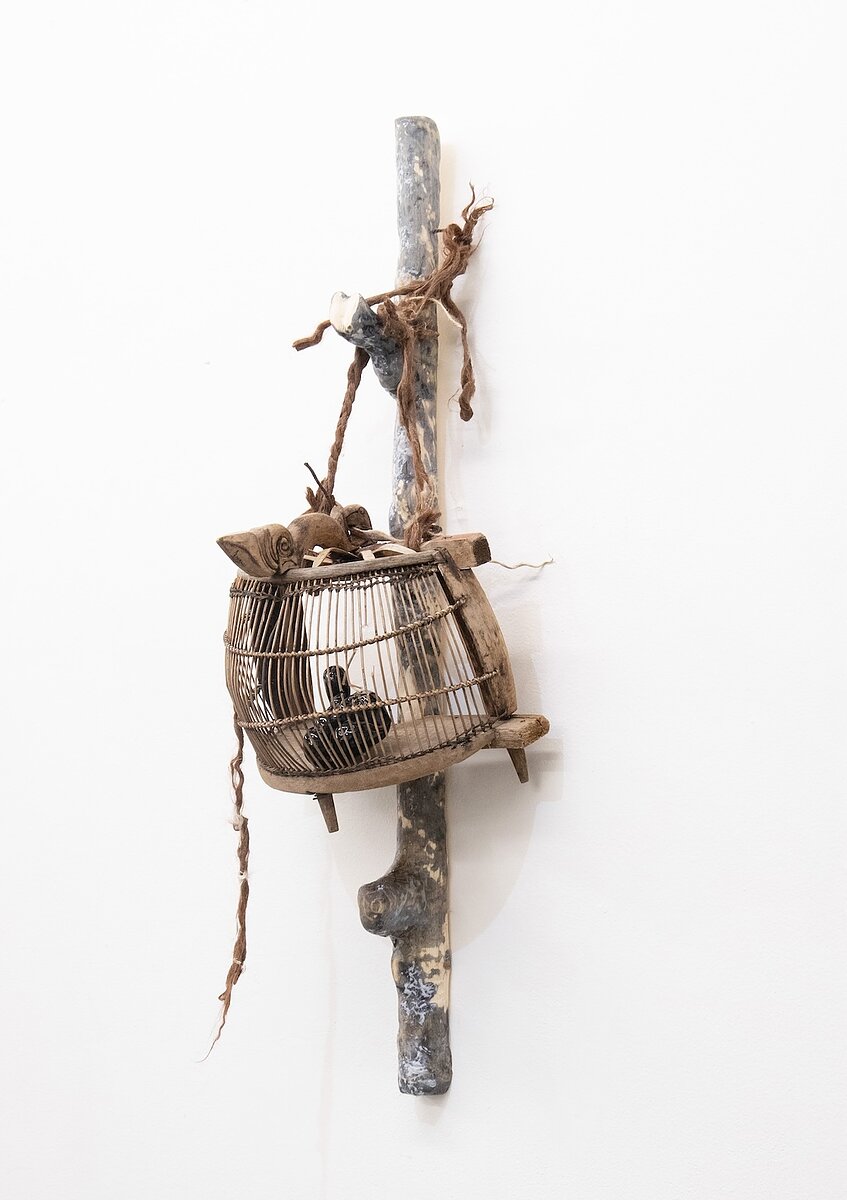
In Birdsong (2025), a readymade birdcage from Indonesia becomes a vessel through which Yan traces the entanglement of patriarchy and colonial history. In Javanese culture, an idealized masculinity has been summarized through the possession of house, wife, horse, dagger, and bird, with birds serving as markers of status. Under Dutch colonial rule, the bird trade expanded dramatically, spreading from elite circles to the broader urban middle class, while rare species were exported to Europe.
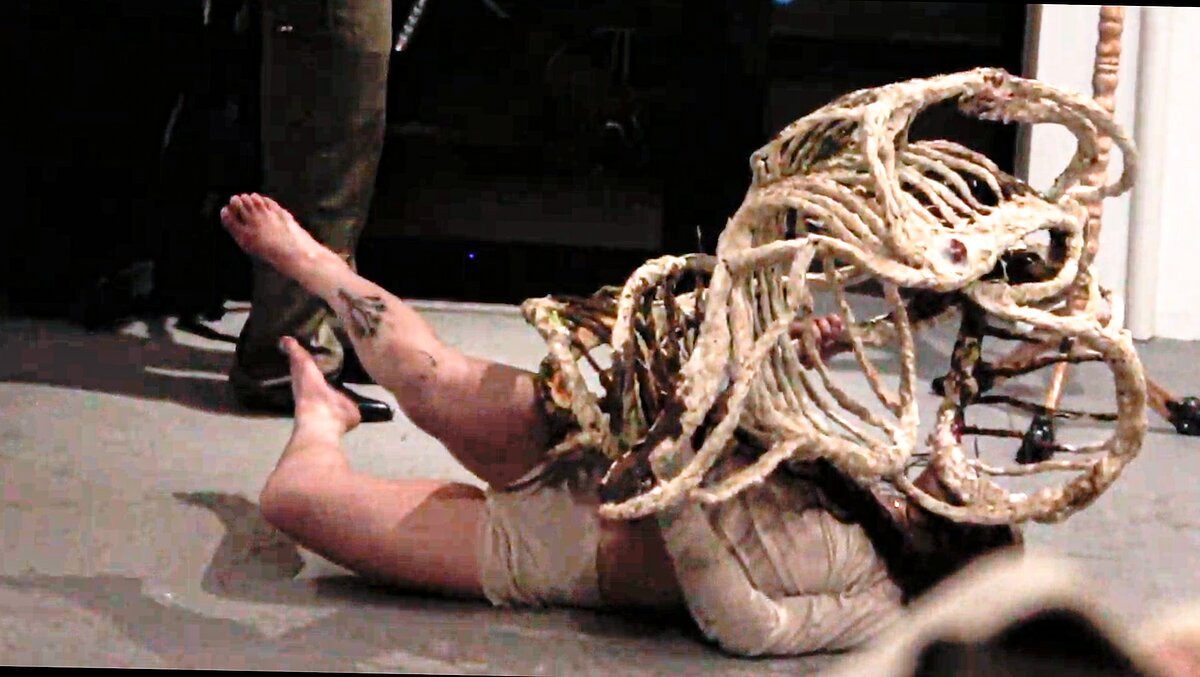
To activate the installations and intensify the bodily experience for visitors, the exhibition also hosted an evening of performances. In the opening act, Qiujiang Levi Lu used vibration sensors held inside the mouth to transduce the body’s interior tremors into sound, producing an incantatory sound art that evoked primitive tribal ceremony. In the second performance, Madison Wada entered the fenced enclosure, negotiating its boundaries through movement before retrieving one of Yao’s bone-like sculptures, The Spore (2025), from the ground. Accompanied by Hideo Rakudou’s flute, Wada’s dance explored how the body submits to, resists, and is ultimately reshaped by structure.
What ultimately distinguishes this exhibition is how both artists move outward from personal pain. The sculptures metabolize suffering into something stranger and more durable. Less confession than evidence. Less wound than fossil.
“Feeding the Load, Regulated Dosage” is on view at Frisson Gallery through April 4, 2026.
—Peiyue Wu is an art writer and journalist based in New York City. She holds a Master’s degree in Art History from the Institute of Fine Art at NYU. Her art reviews have appeared on various magazines and peer-reviewed academic journals such as Journal of Curatorial Studies. She received an Honorable Mention in the 2024 Asian American Journalists Association (AAJA) Excellence in Arts & Culture/Entertainment Reporting. Beyond art, she also writes about China tech and business, with a keen interest in how they are reshaping labor relations, social norms, and the humanities.