In Remembering the Dead, “Jesa” Reminds Us Not to Forget the Living
In Jesa, a new play at the Public Theater by Jeena Yi, four Korean American sisters reunite to remember their late parents. The title refers to the Korean tradition, rooted in Confucianism, that involves offering food, wine, and prayers to ancestors, usually on a death anniversary or during a major festival. But as these siblings exhume fond and fraught memories, old wounds reopen, secrets spill out, and they are forced to confront frayed relationships and the disarray of their lives left behind on this earth.
The heated proceedings take place in the home of the second sister Grace (Shannon Tyo), which she proudly describes as a “Cape Cod-style house” in suburban Orange County, California, shared with her unseen husband and nine-year-old daughter. Grace is high-strung (“Don’t tell me to relax.”) and seems to have inherited her mother’s sense of duty and its attendant frustrations. It’s been a year since her mother’s passing, and Grace decides to convene the siblings and conduct a “double jesa” for their parents.
One by one, her sisters arrive. The eldest, Tina (Tina Chilip), is a bull in a china shop, a foul-mouthed chef who prefers glugging soju to boricha (barley tea). If Grace is emotionally too closed, Tina is too open. Brenda (Christine Heesun Hwang), the third sister, is flighty and artsy, a New York-based theater director who rarely sees the family. Her complaints about unfulfilled dreams smack of privilege and comfort. Lastly, Elizabeth (Laura Sohn) is the youngest and richest, a Legally Blonde type who chirps about a new face cream and earns a cushy income in finance.
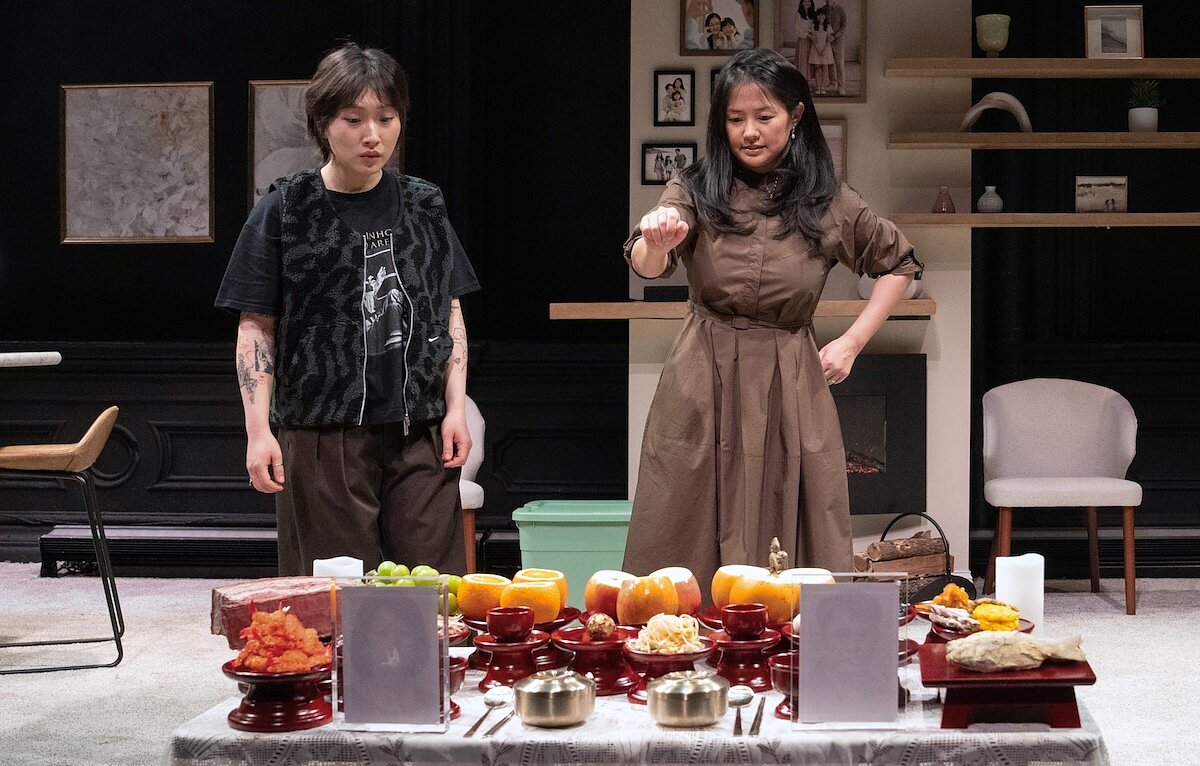
Traditionally, the ritual of jesa is a reflection of deep-seated patriarchy. The ritual is observed by men, led by the firstborn son, in honor of the family’s male ancestors. And yet all the labor involved is performed by women: days of cooking and putting together an elaborate feast—of jujubes, chestnuts, dried fish, pork belly, vegetables, steamed rice, and so on, along with the plumpest apples and pears—to say nothing of the clean-up after.
But this play’s gender-flipped version of jesa departs from tradition. As with any urban diaspora, families shrink and customs erode. We see the sisters experiencing a cultural limbo: struggling to recall the sequence of steps, when to bow, when to do “the rice thing,” how to pour the cheongju (rice wine). Elizabeth suggests consulting YouTube or a jesa app for guidance. Later, on a call with an aunt in Korea, the sisters mostly nod and smile wordlessly, unable to communicate in Korean.
The cast is kept busy throughout the production, juggling tons of props including real knives for scenes involving food prep, executing choreographed altercations, and oscillating between emotional extremes. Playing the oldest sister, Chilip is particularly good at summoning the fiery rage that the script demands and conjuring laughs from the audience. Her humor can be cutting and hurtful, but it also slices through the heavy issues tackled by the play, like cycles of violence and feelings of failure.
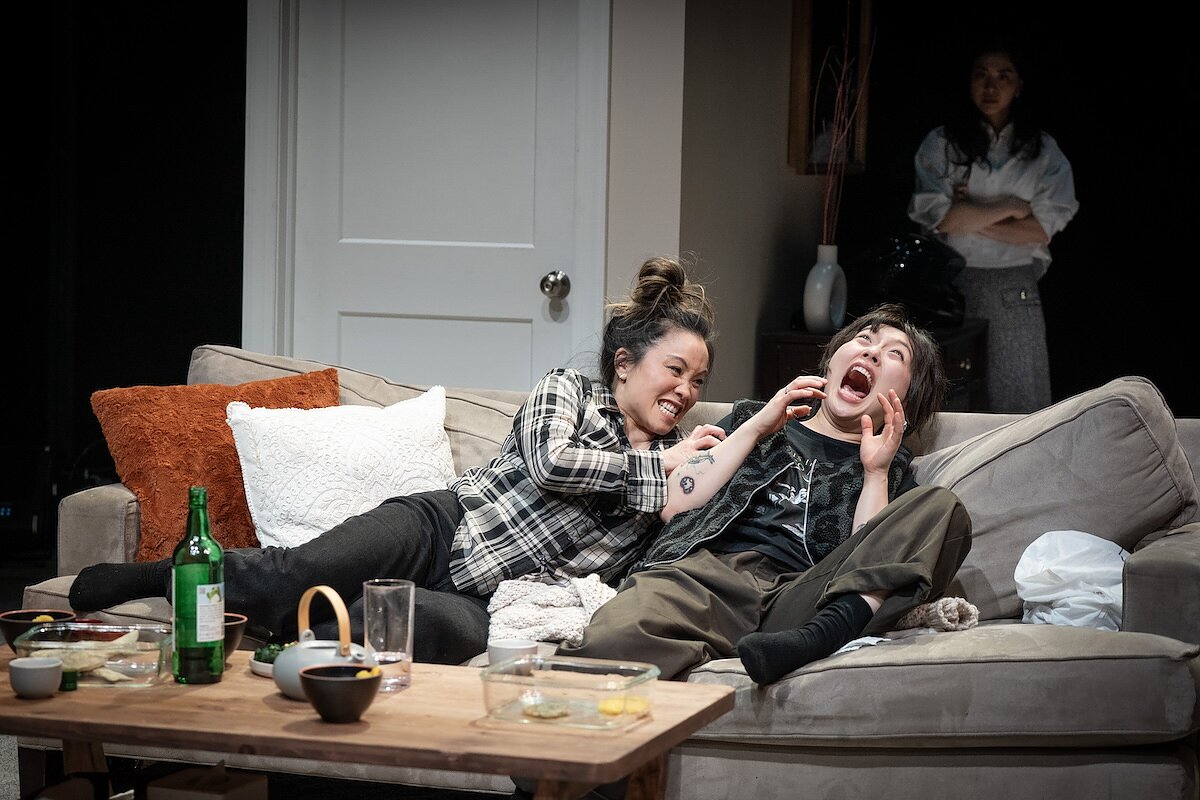


Jesa marks Jeena Yi’s debut as a playwright. (She met the play’s director Mei Ann Teo in Columbia University’s theater program and currently appears on Broadway in David Lindsay-Abaire’s The Balusters.) Her writing bursts with humanity and captures a nuanced family portrait, scars and all, though the script could use tweaks and trims in spots—some arguments are overly dragged out, and vital information like the order of siblings is rather buried.
In a recent playwrights’ conversation at Asia Society presented by Asian American Arts Alliance, Yi spoke about how she reworked the play’s ending after it went into production, when she realized the possibilities of heightening its drama with light and sound. The cataclysmic moment she was referring to—simultaneously a seance and an exorcism—powerfully illustrates how the more you strain to hold things together, the more you are bound to buckle. This unbearable pressure accumulates from the weight of tradition and the impossible standards of family: the ones our parents hold us to, and the ones we judge them by.
For much of the play, the jesa table, upon which the feast is laid, is placed center stage. It is a confluence of past and present, a center of gravity that draws the siblings together and threatens to tear them apart. Food items balance precariously on footed plates like a house of cards. When the delicate arrangement collapses, however, the sisters instinctively and hearteningly scramble to rebuild the altar. As they do so, they discover a new respect not just for their parents, but also for themselves and for one another.
Jesa runs through April 12 at the Public Theater.
—Fred Voon is an arts writer from Singapore who has contributed features and criticism to the Observer, MILIEU, IMPULSE, Plural, Art & Antiques, and The Art Newspaper.