Miwa Neishi and Toshiko Takaezu’s Ceramics Trace History in “Harmony of Time”
Miwa Neishi has practiced Japanese calligraphy since she was ten, and it remains a steady influence on her clay creations. Her pieces convey unbroken lines and sweeping brushstrokes. They embody balance, harmony, and follow-through. “Everything intertwines,” she said.
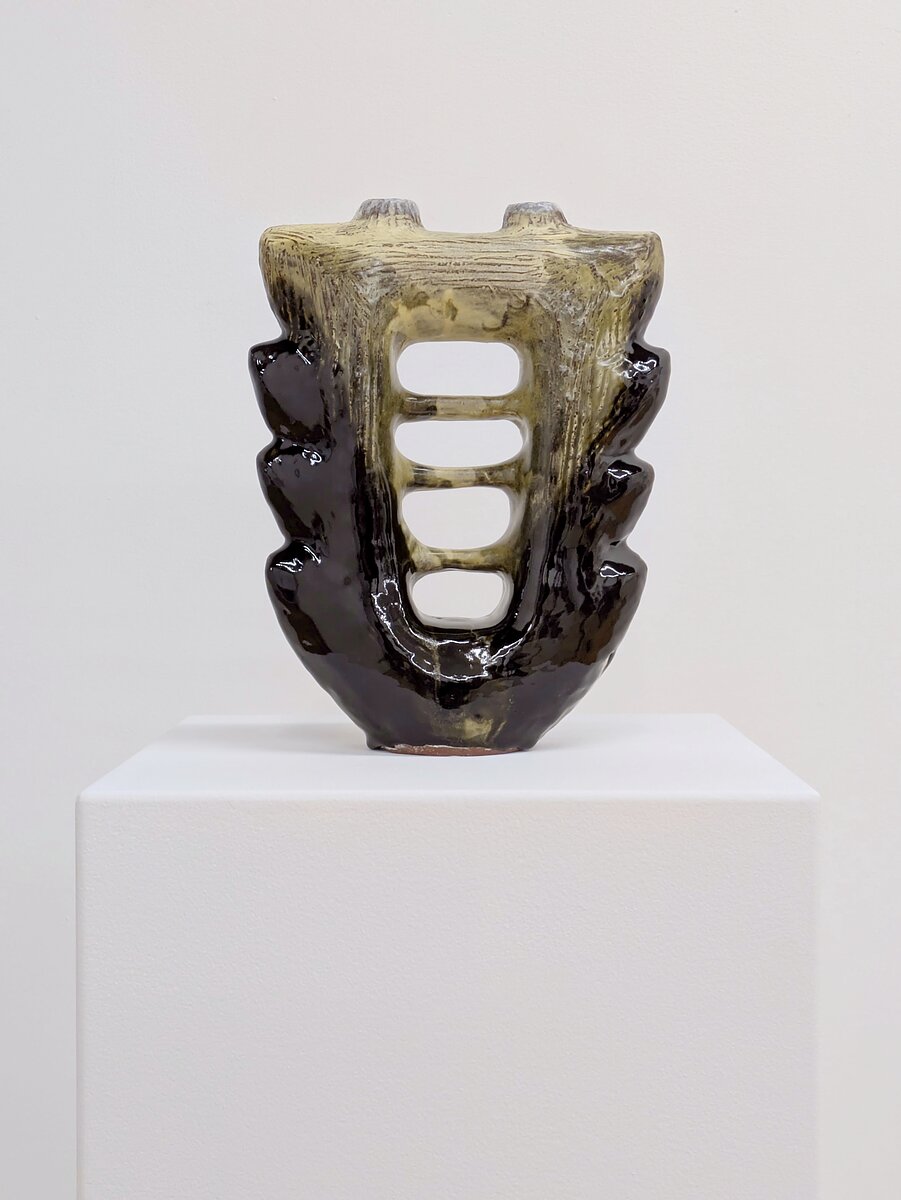
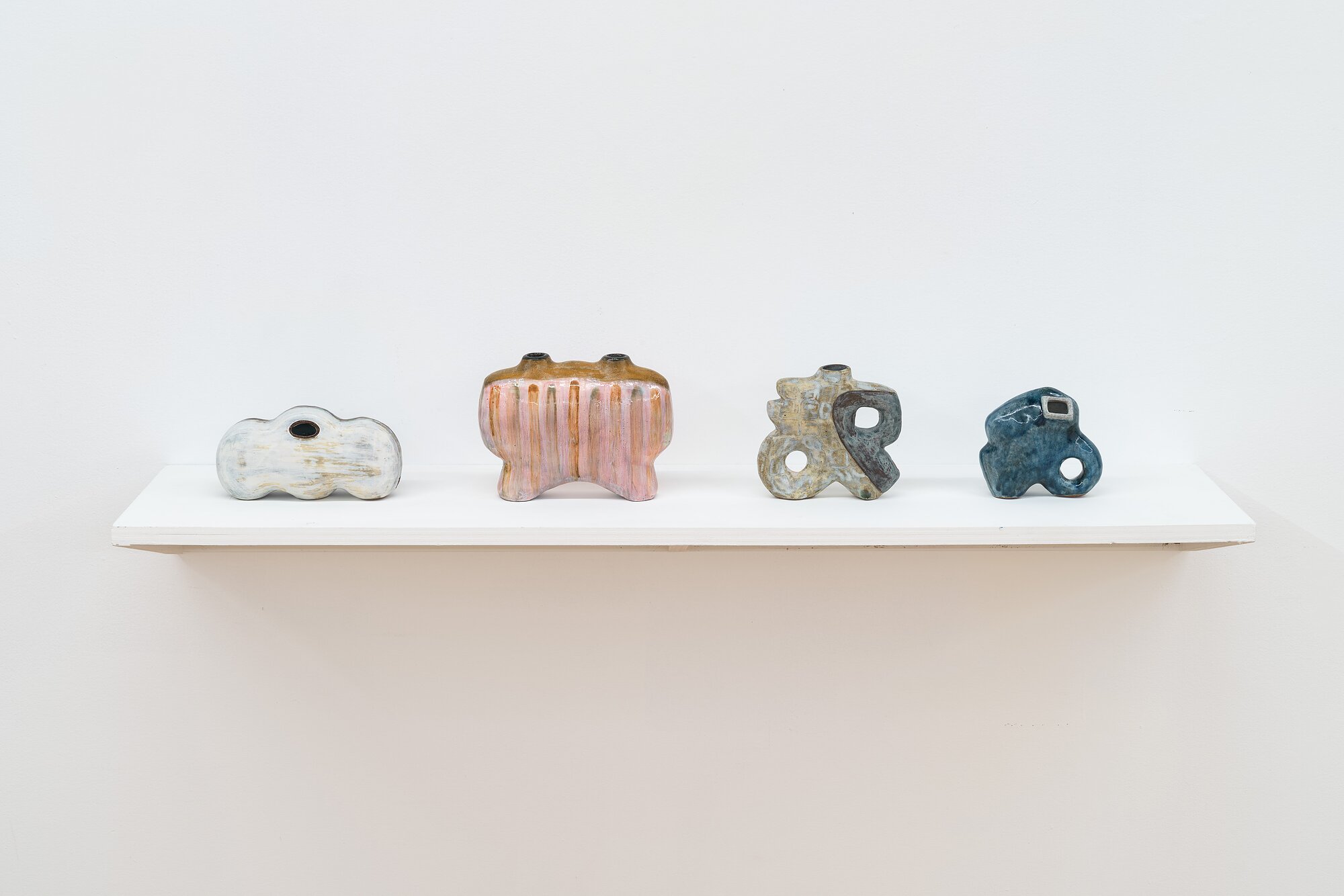
Some works are inspired by specific characters, their shapes allowed to mutate and evolve. Uma 馬 (Horse) (2025), which marks the current Lunar New Year (and happens to be Neishi’s Chinese zodiac sign), roughly follows the contours of the original kanji. Meanwhile, Tei 定 (Fate) (2025)—a squarish enclosure joined to two loops in opposite corners—is a more abstract form with no strict correspondence. Over the years, Neishi has returned to this particular shape again and again, here on its largest scale yet.
Originally from Tokyo, Neishi has lived in the US for the past 13 years. Here, she points out, it is rare to come across her native language. “This is what being homesick made me make,” she said. “I didn’t realize how attached I was to Japanese letters.”
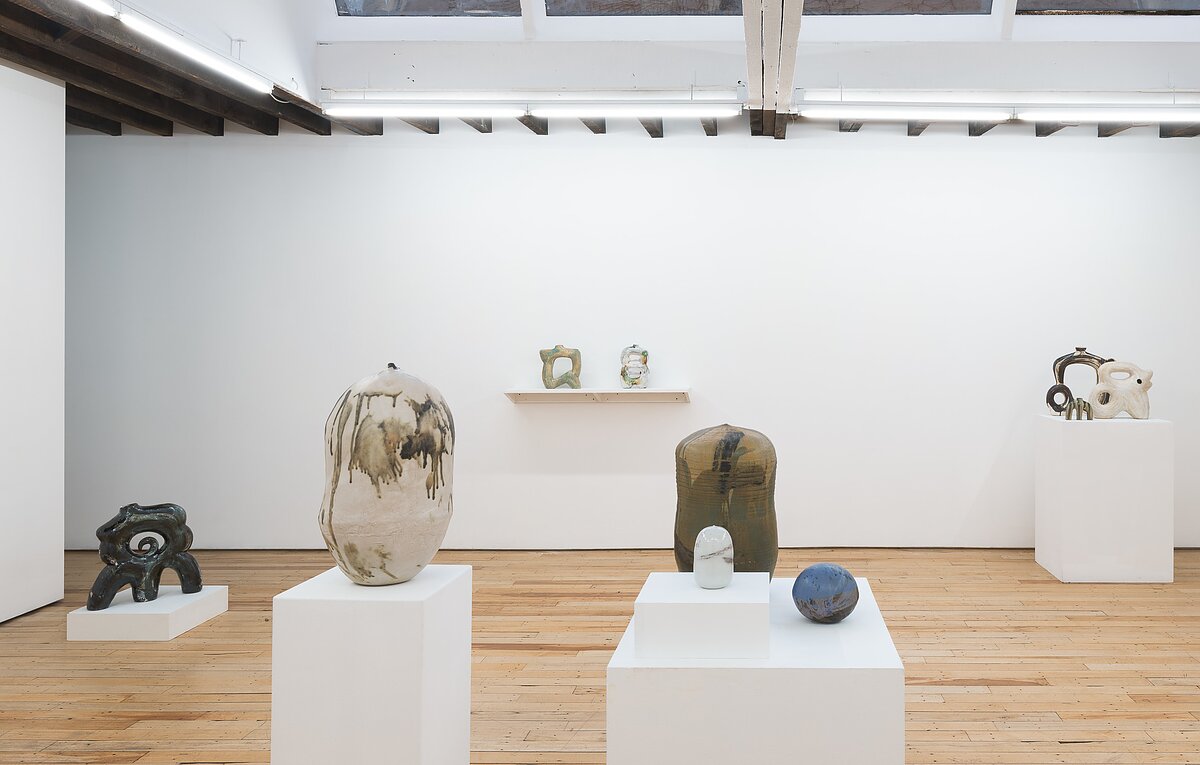
In “Toki-no-Wa (Harmony of Time)” at Uffner & Liu on the Lower East Side, 15 of Neishi’s works are presented alongside four pieces by Toshiko Takaezu, the Japanese American artist who died in 2011. Curated by Lucy Liu, who became a partner at the gallery in 2025, the show brings together the two female ceramicists, born nearly seven decades apart, who share origins in Japan, a love for bulbous forms, and a curious connection to Ohio.


Born in Hawaii to parents from Okinawa, Takaezu studied at the Cranbrook Academy of Art in Michigan, where the Finnish ceramicist Maija Grotell cultivated her individuality. In 1955, she spent a seminal eight months in Japan to nourish her roots: studying Zen Buddhism, the Japanese tea ceremony, and visiting the potters Shōji Hamada and Tōyō Kaneshige. Returning to the US, Takaezu taught for a decade at the Cleveland Institute of Art, then for 25 years at Princeton University.
Takaezu is known for her bold abstract expressionist glazing of “closed forms,” vessels with mouths too narrow to receive flowers yet big enough to release air during firing. Her round “Moon” pieces have a tiny hole in the bottom instead. By closing the vessel, Takaezu erased its function and purified its form. Another ongoing exhibition, “Dialogues in Clay” (through July 5) at the Princeton University Art Museum, is a broader survey that includes some of her larger pieces.
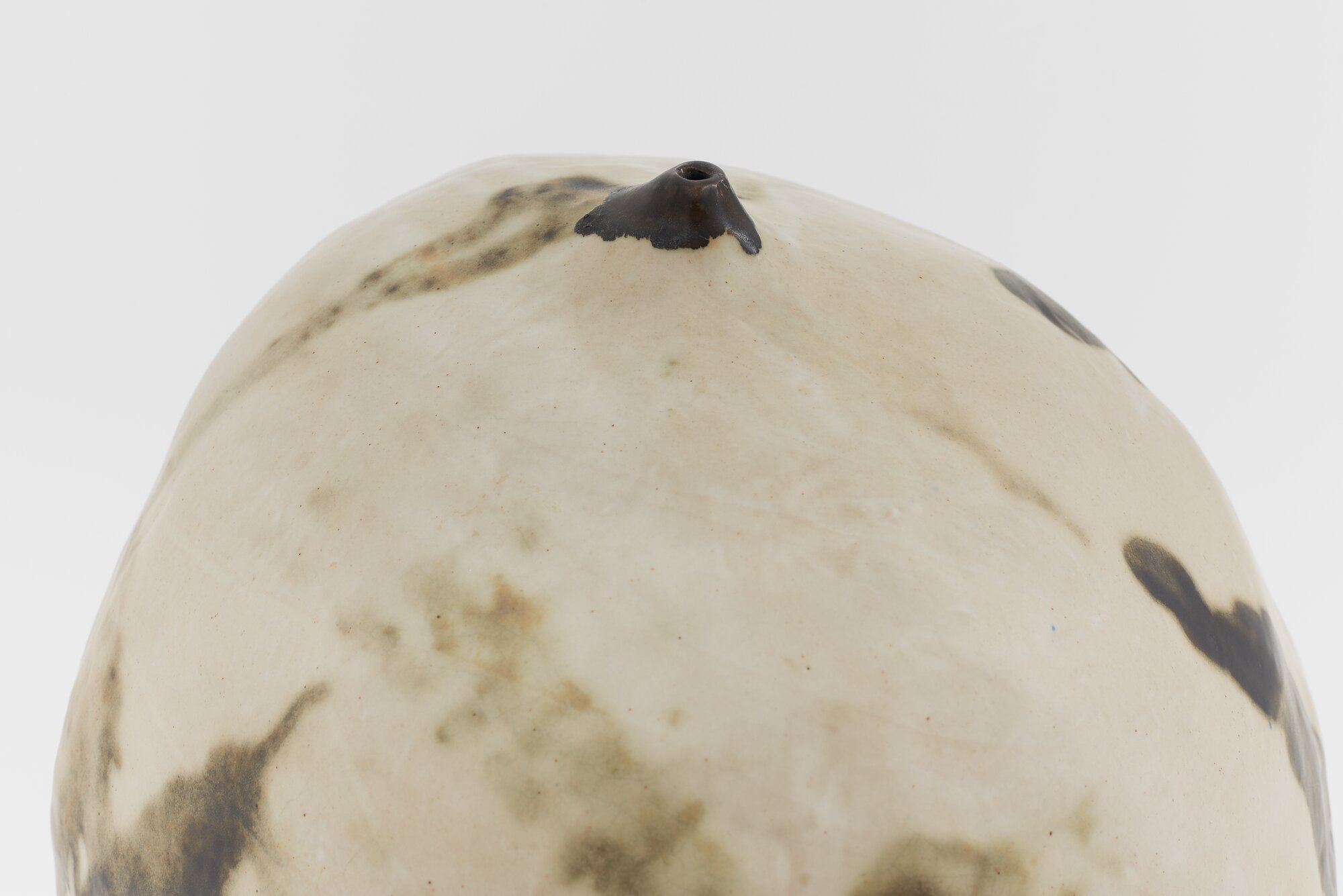
At Uffner & Liu, Takaezu may be the guest artist who takes second billing, but her pieces are given pride of place in the center of the room, as if Neishi’s works on the periphery are all bowing down in reverence. Neishi first encountered Takaezu’s work during her MFA studies at Kent State University in Ohio. At the school gallery where she worked part-time, she recalls handling one of Takaezu’s “Tamarind” pieces—a stack of three globes fused to form a pod—for a group show. “When I saw her work, I was kind of confused,” she said. Is it a sculpture, she wondered, “or is it a vase still because it has the shape of a vase?”
Over her university years, Neishi explored terracotta sculpture and multimedia installation, but eventually gravitated toward stoneware through ceramic classes at Kent State. Her professors included Kirk Mangus and Eva Kwong, former students of Takaezu’s at the Cleveland Institute of Art, just 30 miles away.
Since moving to New York, Neishi has visited a couple of Takaezu exhibitions: at The Noguchi Museum, while she was working at its shop, and at the Museum of Fine Arts, Boston, where she was struck by a juxtaposition of two early pieces. The way a single-spouted teapot seemed to morph into a two-stemmed vessel resonated with her evolution abroad, her art branching off into something new.
The exhibition’s title, “Toki-no-Wa,” is multivalent. “Wa 和” means harmony—it is part of Neishi’s first name, and it’s what Japan was called in eras past. “Toki 時” is time, a vital element in the firing process and the maker’s journey. “There is always such a thing as timing,” Takaezu once said. “I know when to change.”
Neishi thinks of clay as an age-old material, and she pays homage to prehistoric practices in Jōmon Japan. The wide stances and anthropomorphic cuteness of her pieces may be considered traces of dogū, ancient humanoid and animaloid figurines whose purpose remains a mystery to this day.
In her studio at Sculpture Space NYC in Long Island City, Neishi mixes clays and formulates glazes naturally colored by metals like iron and copper. Her newest piece in the show, Kaminari 雷 (Lightning) (2025), features three layers of glaze: yellow beneath glossy black, and a thinned-down version of the black in between. The black layers were splashed on, a thrilling gesture that could be linked to abstract expressionism or the haboku technique in ink wash painting.
Whether a product of Eastern or Western influences, Neishi certainly belongs to a lineage of women relishing the freedom to experiment and forging cross-cultural identities as contemporary artists. Her spirited research into glazes echoes Takaezu’s, which echoed Grotell’s before her.
For centuries, the art of ceramics in Japan has been dominated by men; women are not typically accepted as apprentices. Of the 36 ceramicists certified as Living National Treasures since 1955, none are female. And yet, pots and jars and figurines of the Jōmon era—like all Neolithic pottery—were crafted by women. Depending on one’s definition of “tradition,” female ceramicists like Takaezu or Neishi could be seen as a radical rupture, or a rightful return to the beginning, both in practice and in form.
“Toki-no-Wa (Harmony of Time)” is on view at Uffner & Liu through March 7, 2026. “Dialogues in Clay” is on view at the Princeton University Art Museum through July 5, 2026.
—Fred Voon is an arts writer from Singapore who has contributed features and criticism to the Observer, MILIEU, IMPULSE, Plural, Art & Antiques, and The Art Newspaper.