Not All Representation Feels Like Home
The first sign is usually the language: A character who is supposed to be Chinese steps into the spotlight and says a line in Mandarin. The consonants fall in the wrong places. The tones drift. The sentence lands with the flattened weight of something memorized phonetically, detached from breath, from upbringing, from the thousand tiny pressures that make a language belong to a body. Around me, a mostly non-Chinese audience accepts this without hesitation. They have received the message: This is an Asian story.
To me, this experience creates a specific, strange distance. It is not the distance of exclusion; the play has already invited me in. On paper, I am ostensibly included. But in my body, I am not convinced.
I do not want to dismiss the significant progress of seeing more Asian writers programmed, more Asian performers centered, and more Asian stories marketed as central rather than marginal. Many of us came of age in a culture where Asian presence in American culture was either ornamental or absent altogether.
It matters that Asian representation on New York stages has expanded. Visibility can change what younger generations think is possible. It can alter expectations. It can open doors.
But visibility alone does not settle the question of who a work is actually for.
What I keep seeing, in theater and in adjacent cultural spaces, is a particular kind of Asian visibility: polished, marketable, easy to read from a distance. A production borrows a few lines of Chinese or Korean. A set leans on East Asian visual cues. A script includes immigrant parents, food, silence, obligation, maybe a joke about pronunciation or assimilation. The audience recognizes the package immediately. The work is praised for specificity.




This distinction matters. Recognizability is external—it gives the dominant audience enough information to identify the category. Specificity is structural—it shapes the tempo of a scene, the pressure inside a family, the way love and authority sounds when spoken across hierarchy, shame, duty, and restraint. Recognizability tells the audience what culture they are looking at. Specificity tells the people inside that culture whether the work actually knows them. A lot of contemporary Asian representation succeeds at the first and stumbles at the second.
You can feel this most clearly in the use of language. When a production asks an actor to play a Chinese character and sprinkle in Mandarin without any real fluency, the problem is not simply bad pronunciation—it is a whole artistic logic. Language, in these instances, has been treated as surface. Its function is atmospheric. It signals heritage, deepens branding, and assures the audience that the work has roots somewhere beyond English. But language is never just flavor. It carries implications of class, relationships, regionality, context. Once all that texture disappears, language stops doing dramatic work and becomes décor.
The result can be oddly alienating for the very people the production claims to represent. You hear something that belongs to your world, but only as citation—the shape is there but the pulse is missing. This is why I keep returning to a postcolonial question:
That question feels urgent now, as mainstream American theater has become much more comfortable presenting “Asian stories,” while still remaining far less willing to let Asian cultural logic determine the terms of the production. The work can be Asian as long as its Asian-ness remains manageable—easy to market, easy to universalize, easy to detach from linguistic and historical density.
Universality is often where the flattening begins. In practice, it has too often meant emotionally readable to the mainstream, even when that readability comes at the expense of cultural precision. The demand is familiar: Keep the signifiers but soften the opacity. Preserve the feeling of difference, but not so much that the audience has to work too hard. Make it rooted, but frictionless.
You can see the larger version of this logic in the backlash around the musical Maybe Happy Ending. When the Broadway production announced the non-Asian actor Andrew Barth Feldman would be taking over Darren Criss’s role as Oliver, many in the AAPI theater community objected, arguing that the issue was bigger than one contract or one performer. The controversy exposed a deeper anxiety: Even when a work arrives with Korean origins, Korean creators, and an Asian visual and narrative world, its specificity can still be treated as transferable once it enters the machinery of mainstream success. Asian identity becomes part of the production’s appeal, but not necessarily part of its nonnegotiable structure.
That is the wound I am trying to name: It is not that Asian work is disappearing. It is that Asian work is often being translated before it reaches us, rearranged for comfort and trimmed into legibility.
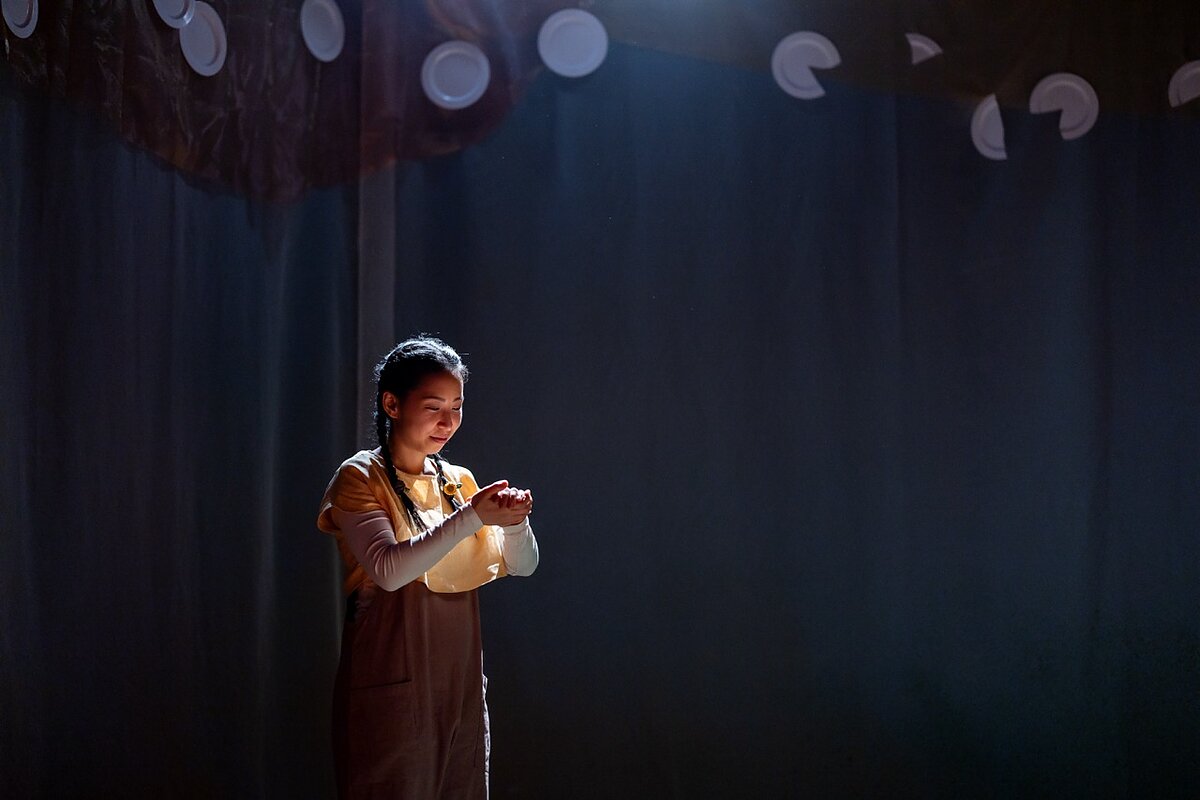
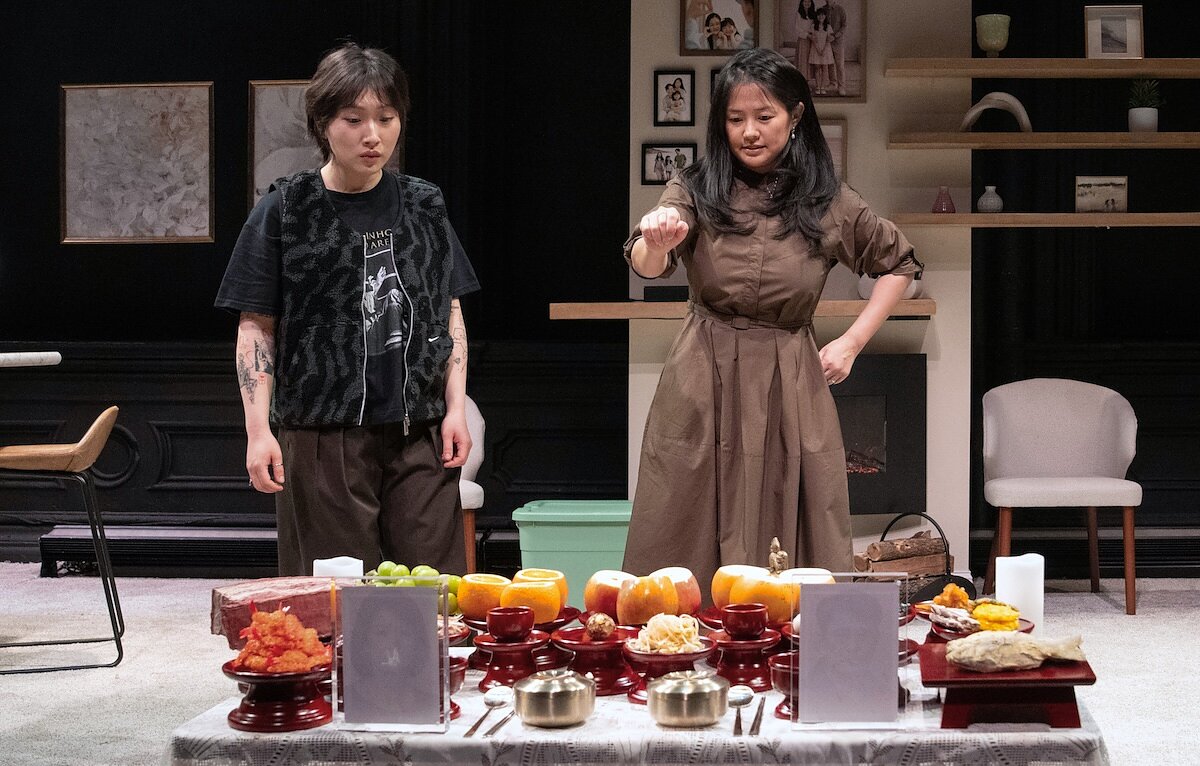
Productions such as Jeena Yi’s JESA and Zoë Kim’s Did You Eat? offer a different possibility. In both plays, language and family dynamics felt embodied rather than ornamental. The Korean language was not employed as decorative proof that the work was Asian; it moved with the rhythm of the room. The silences, interruptions, jokes, and obligations carried their own pressure. They did not seem arranged for a mainstream gaze first, then translated back toward us. These plays trusted their own cultural logic, and that trust made the work feel lived-in.
When it comes to representation, what many Asian audience members are looking for is not simply resemblance—we are looking for cultural intimacy. We are listening for whether the work understands how pressure circulates in the room. We are watching for whether a family scene has the right emotional geometry. We are listening for whether the language lives in the actor’s body or just passes through it on the way to applause. Feeling home onstage is built from these decisions.
It is built from casting that respects more than appearance; from directors who know that multilingualism is not garnish; from dramaturgy that treats culture as more than reference material; and from institutions willing to admit that “Asian” is not a stable aesthetic and that representation without accountability can still leave the represented outside the room.
Theater has always involved translation, imagination, risk. I am not asking for purity—I am asking for rigor and a deeper standard than just symbolic inclusion. If a production wants the authority of cultural specificity, it should also accept the obligations that come with it.
Otherwise, we end up with a familiar theatrical arrangement: An Asian story that looks convincing from the orchestra, photographs beautifully for marketing, and leaves part of its own audience sitting quietly in the dark, aware that what they have just witnessed is not quite erasure, not quite recognition, and certainly not home.