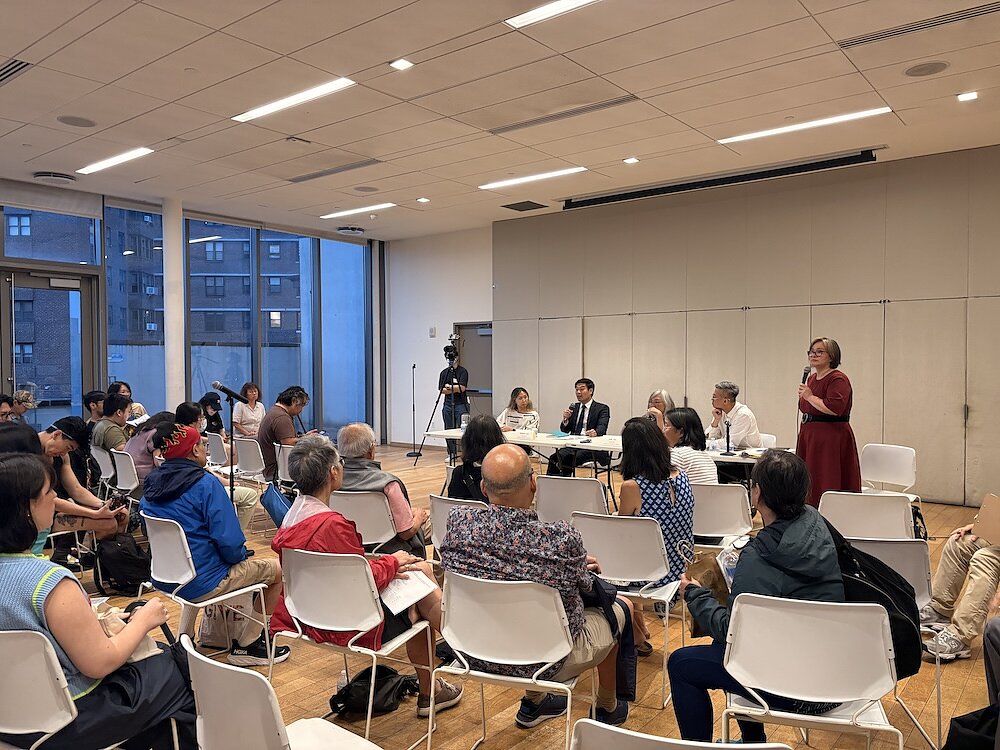
Dispatches from MOCA Town Hall and YAD Picket Line
There are few events in the arts that feel like a royal rumble, filled with infinitely entangled storylines and pent-up tension aching to be dispelled through a dramatic fight. The Museum of Chinese in America’s “Community Town Hall” was just that. In one corner was the Manhattan museum, which billed the event as an “open forum” in which they would address “community concerns.” In the other corner were skeptics who opposed the museum’s acceptance of “jail money”—colloquial shorthand for a $35 million gift bestowed by the city government as a community concession for building a new jail nearby.
I won’t rehash the extensive reporting done by the artist collective Chinatown Art Brigade, and media outlets like Hyperallergic, The New York Times, and New York Magazine. Rather, my intention is to document the event for future reflection and for the greater majority who could not attend. The museum held the event at the Manny Cantor Center; a decision that museum leadership made in hopes that the public would be more willing to enter without violating the picket line in front of the museum, which has been active ever since the controversy broke out over half a decade ago. Nonetheless, the anti-gentrification organization Youth Against Displacement announced a week prior that they would move the picketline from MOCA to the event. Their post on Instagram read, in part, “boycott this town hall, and join the picket outside!”
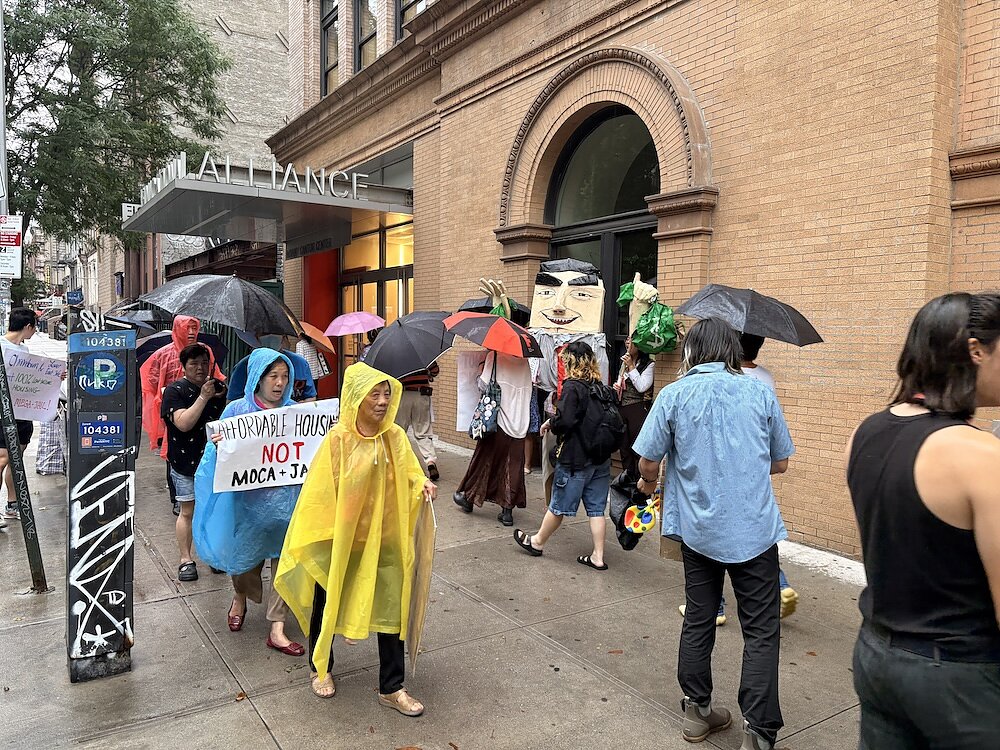
The weather that day seemed to match the mood, unleashing torrential downpour, flash flood warnings, and a tornado watch for the region. That didn’t stop a sizable group of picketers from gathering in front of the building. Holding signs that read “Museum of Corporate Asians” and chanting slogans like “Chinatown not for sale,” the dissenters seemed high-spirited. I asked one of them, who spoke with me under the condition that they remain anonymous, what they hoped to achieve outside that would be more effective than challenging MOCA during the town hall. “I think that it’s very clear that this town hall was presented as a neutral space where different sides can come together, but it really legitimizes their theft of $35 million dollars and the damage they’re doing to the community,” they said. In short, the organizers felt burned by the museum so many times that it was pointless to engage in dialogue at this juncture.
One organizer named Aaron Yin reasoned with protesters that he planned to go inside in order to challenge MOCA but didn’t want to go against the picket. “In front of the museum or at their gala, a picket makes sense because only supporters go inside,” he said. “But I just want to make sure there are people who disagree with MOCA inside tonight too.” The picketers seemed to nod and understand (no screams of “Shame!” that typically taunt museum gala-goers), but many still worried that attending the event and documenting what transpired would receive their condemnation. Michelle Campo, vice president of the Bowery Alliance of Neighbors and a member of Coalition to Protect Chinatown and Lower East Side, spoke to me as she adjusted her rain poncho. “We’ve been boycotting MOCA for a while, and they’re doing this town hall to whitewash themselves,” she said, noting that MOCA repeatedly tried to dismantle the boycott and called police on protesters. “They do not represent Chinatown. This organization”—she said while gesturing to Youth Against Displacement—“represents Chinatown.” I took one last look at the group’s unflattering paper effigy of Michael Lee, president of MOCA since 2024, and walked in with Yin.
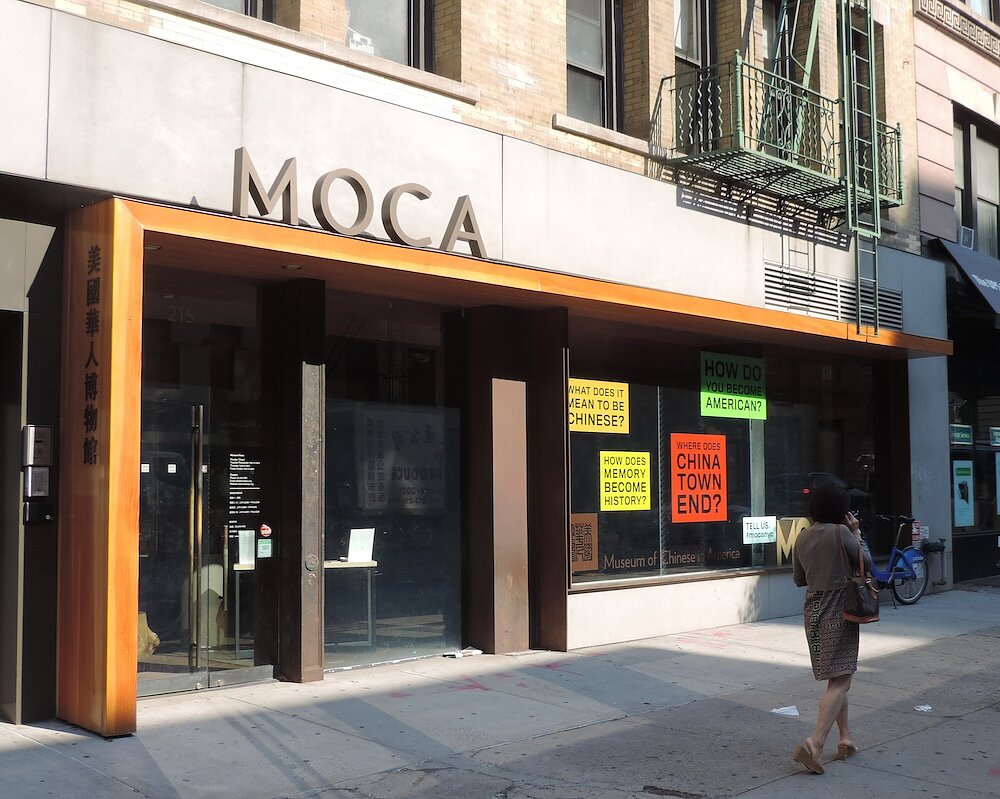


The event began with personal introductions from panelists: Michael Lee; Vic Lee, co-founder of Welcome to Chinatown and a newly minted Advisory Board member; June Jee, a museum trustee and community affairs and strategic partnership consultant, and MOCA’s chief curator, Herb Tam. The moderator, whose name the museum withheld until the event began, was unveiled as attorney Mariam Manichaikul (she is also the chief mediator and regional director for New York State’s public employment relations board in Brooklyn; this was not disclosed at the event). Many of the panelists described their connections to Chinatown, including attending school in the neighborhood and having nowhere to turn to after experiencing racial discrimination. A museum seemed to be the solution to the desire for community and knowledge.
Michael Lee delivered an opening statement that echoed similar missives previously issued by the museum, denying culpability by portraying it as a matter of poor timing and manipulation by the city. The museum had been applying for capital funding to buy its building at 215 Centre Street since 2015, ever since the building’s owner (listed in public records as “Grand Machinery Exchange, Inc.”) expressed wanting to list the building for sale once the museum’s lease expired in 2020. Mayor Bill de Blasio only approved it alongside his plan to close Rikers Island and build Borough-Based Jails in 2019. His voice grew strained as he emphasized an unglamorous detail: that rejecting the funding would have meant the museum would close. “Whether MOCA accepted the funding or not, the jail initiative would still move forward. This put the museum in an impossible position, because certainly it did not want to be associated with a jail it opposed,” he said. “But rejecting the funding would ultimately mean the museum would close when the building was sold, unless MOCA used the funding to buy the building itself.” The museum’s dire financial state is confirmed in interviews with the museum’s former director between 2015–2023, Nancy Yao, who told Yale School of Management that by December 2019, the museum had just $50,000 in its bank account and missed payroll twice.
The imminent possibility of a shuttered museum seemed to inspire many speakers who stepped up to the mic to underscore the importance of saving Asian American history, Chinatown as a precious ethnic enclave, and Chinese artifacts for future generations to understand. Longtime MOCA supporter and former A4 board member Rocky Chin cited the parallels between the museum and the town hall venue, Manny Cantor Center, which was founded by German Jewish immigrants in 1889. “Despite the internal struggles and debate, supporters kept their eyes on the prize, which is what I think we need to do today,” he said. Robert Lee, a founder of A4 and Asian American Arts Centre, recalled being part of Basement Workshop in the 1980s and being witness to how “we have all struggled to make MOCA work.” He added, “I’m very saddened to see the kind of young generation that’s out there now and doesn’t realize all that has gone in to build and create and sustain what we thought nonprofits could be doing in a positive way.” Together, their implication was that anyone who stood against the museum simply didn’t grasp how much labor, resources, and history was at stake.
This generational divide seemed to continue throughout the evening. Chinatown veterans who lived through an era without a museum or other avenues to learn about Chinese diasporic identity beseeched audiences to not disregard how meaningful and laborious it was to even have MOCA. Karen Chun, whose father was on the board of Chinatown History Project as one of the initial people bringing in objects to MOCA, said, “Our history deserves to be honored and saved and taught. By destroying MOCA, we destroy our history. Who else is going to be recording it, and where else can our children learn from?”
Later in the evening, leadership expressed some regret about past actions that seemed to cause more division than good. After all, the town hall had taken over five years to stage. In a letter to MOCA’s board of directors from the Asian American arts network Godzilla in December 14, 2020, obtained by The Amp, artists such as Todd Ayoung, Shelly Bahl, Mel Chin, and others threatened to withdraw from a forthcoming exhibition about their work unless the museum would agree to “a community-wide, open meeting with neutral, arms-length facilitation, including an opportunity for deliberative engagement to discuss community needs and alternatives.” By spring of the following year, the museum had not acquiesced, and the would-be blockbuster exhibition Godzilla vs. The Art World: 1990-2001 was cancelled.
“It did take a long time,” said Michael Lee. “I can’t speculate what decisions were made not to host earlier on. I have no idea what those conversations were like, and I wasn’t the leader then. But I’m the leader now, and two years was too long for me to hold this talk.” Under new leadership, some hoped that sentiments towards the museum could change, that we could start with a blank slate. After all, some of the more nuanced demands of the original boycott have lost their edge. Jonathan Chu, a former MOCA board member and landlord who YAD demanded be removed, had not renewed his term and is no longer formally affiliated with the museum. Nancy Yao seemed to operate less transparently; under her leadership, the museum shied away from addressing the jail money through programming. Both were notably absent from the town hall and spared the brunt of the ire that Lee has now inherited. Lee, who is currently also on the board of Chinese-American Planning Council (CPC), was formerly managing director of corporate development at the New York Institute of Finance and executive director for Apex for Youth. “I would definitely go back in time and hold a town hall, you know, right away,” added Herb Tam. “Clearly that’s what people wanted.”
However close to an admission this was, some couldn’t accept anything less than a full confession. Aaron Yin, the activist at the picket from earlier, confronted the panel with a simple question, “Will MOCA ever admit that the $35 million is jail money? Because if they don’t, there will always be friction, friction that other people were worried about. There will always be that friction if MOCA continues to deny.” Two more attendees were invited to speak before museum leadership responded. One of them expressed frustration that this format caused questions to remain unanswered. The moderator retorted that this format intended to save time. Someone seated behind me commented that it “took a lot of momentum out of the questions.”
Yin Kong, founder of Think!Chinatown (locals have begun to affectionately refer to the alternative Chinatown establishment, which includes an art gallery, as “Woke-ah,” a play on MOCA’s acronym), stood to remind panelists: “As someone who was a part of the neighborhood advisory meetings for the jail, I know what was said in that room. That money is 100% connected to the jail.” A few claps of agreement. “I heard your predecessor, Nancy Yao Maasbach, talk about this capital funding. I know it might’ve been asked for before, but it is solidly connected to the jail.” Part of the injury, she implied, was MOCA’s sanitization of its own history, even as it claimed within its mission to rescue the neighborhood’s stories. She further cautioned that without people, MOCA would remain “an empty house.” “If we want to heal, truth has to happen,” she continued. “Why won’t MOCA admit that it has accepted jail money?”
After repeating earlier statements denying the connection, Michael Lee also offered this: “We could say MOCA could have rejected the money, but really, the plan was moving forward. $35 million out of $391 million [in concessions from the city to community organizations] probably wouldn’t have moved the needle, and then again, it put the museum in an impossible position. You could reject the funding, and then close the museum. Probably wouldn’t have changed any outcome, and they ultimately chose to save the museum. And so I think it was a choice they had to make. They never wanted to be tied to the jail … but at the end of the day, when faced with that choice, they chose to save the museum.”
Is it true that the museum closure was inevitable? Some activists insist that the museum could have crowdfunded. After all, the beloved Chinatown bookstore, Yu & Me, raised nearly $400,000 through a Gofundme after a fire ruined their space; though this is pocket change compared to the mammoth $51+ million needed to purchase 215 Centre Street. When a devastating fire broke out at 70 Mulberry, a building that housed MOCA’s archives, Mayor Bill de Blasio promised $170 million to help rebuild with two additional floors. Rather than consider alternatives and risk going public with their financial state, perhaps the museum chose not to gamble.
The idea that there existed a binary choice raised alarm bells. For many, protests against “jail money” became synonymous with destruction of a museum that many had waited nearly 50 years and multiple generations to see come to fruition. “I think that MOCA deserves to exist,” asserted Katie Salisbury, who is working on an exhibition about Chinese film star Anna May Wong at MOCA next year. Ted Chow, who identified himself as a longtime advocate for MOCA and member of a Chinese fraternity at Columbia University, said, “Some of the people here expect the museum to do things that it really isn’t designed to do. I think the location of the jail should be an issue addressed to politicians.” A round of applause followed.
This, of course, is debatable. In 1961, Metropolitan Museum of Art director James J. Rorimer joined the Artist Tenant Association (ATA) in asking the city to intervene in evictions of artists in SoHo. The museum became part of larger momentum that contributed to rallies and, years later, an amendment to the New York State Multiple Dwelling Law to permit artists to remain in their lofts. A more recent example that may come to mind for many is the “Tear Gas Biennial” (2019), in which artist activists like Forensic Architecture and Hannah Black castigated the connection between Whitney Museum’s board member, Warren Kanders, and his weapons manufacturing company that supplied violent riot control gear to disrupt leftist organizing globally. Museums in our contemporary context have been sold to us as not only community spaces but sites to organize and intertwine political and aesthetic inquiry. I would further like to live in a world where the preservation and appreciation of Asian objects does not force us to choose questionable funding sources. But in a deeply unequal world abundant with predators of public space, MOCA supporters implied that this remains a fantasy.
Eugenie Tsai, former senior curator at the Brooklyn Museum and also a member of Godzilla who did not withdraw from the aforementioned exhibition, spoke from her personal experience with capital funding. “I hope that people understand that capital money given by the city…is for one thing only. That is for building,” she said. “It is against the law to spend capital money on anything else.” This alluded to protester’s demands that the city either give back the money or redistribute it among struggling Chinatown businesses; a vote of support for the museum as merely law-abiding pawns of city governance. Liz Ouyang, a civil rights attorney, similarly shifted blame from the museum onto the city. Speaking about her personal experience as a fundraiser, she saw the community concession as a common practice whenever the government wanted to put “an unpopular building in a low-income neighborhood.” “To the city, this was jail money,” she said. “What’s missing in this whole conversation is the history of Asian American organizations not getting federal, state, and local city money.” And she’s right: according to the Coalition for Asian American Children and Families, AAPI nonprofit groups receive less than 5% of New York City’s grant funding, despite Asian New Yorkers making up nearly 18% of the city. Statistics at a national level are even more tragic. According to Asian Americans / Pacific Islanders in Philanthropy, just 0.34% of US philanthropic dollars reach AANHPI communities. That’s 34 cents out of every $100 awarded by US funders.