Making Home Within at “Re-Orienting”
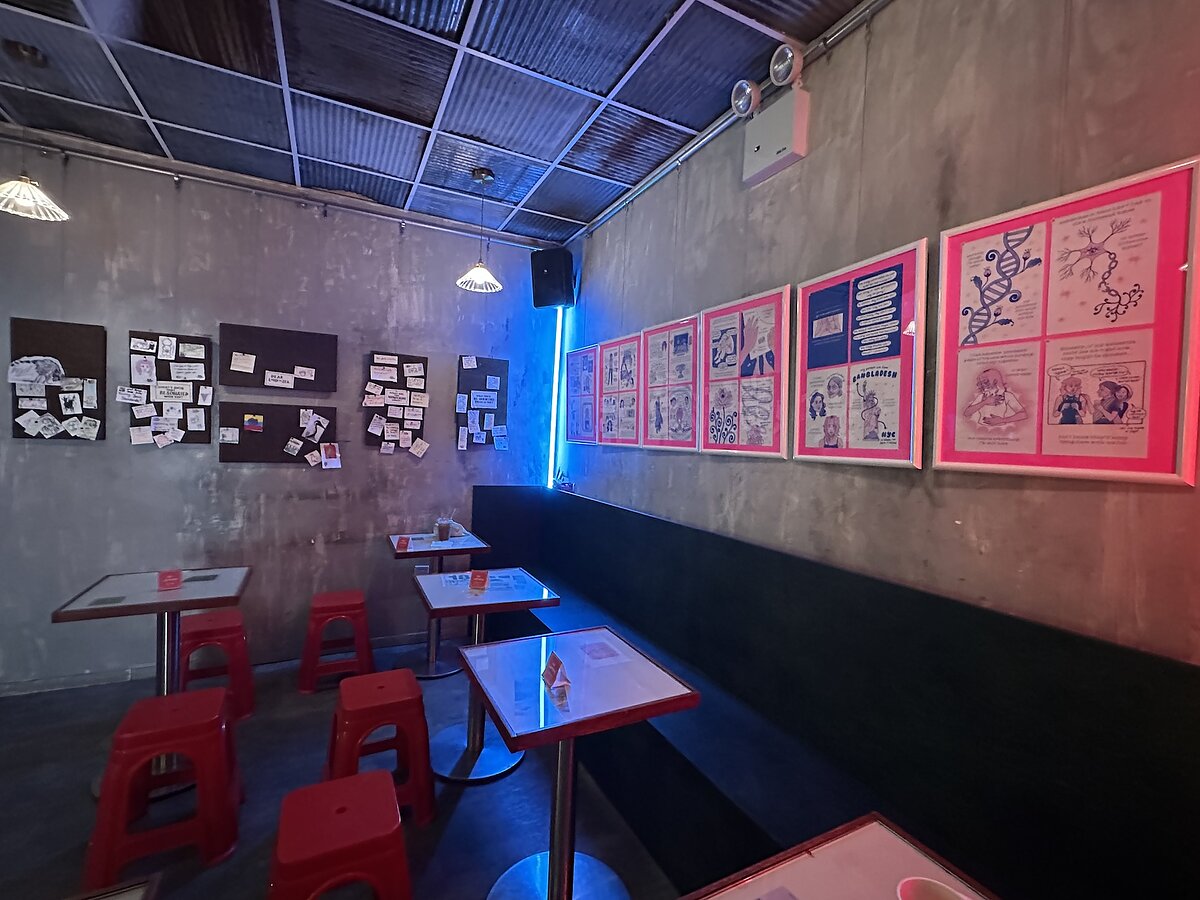
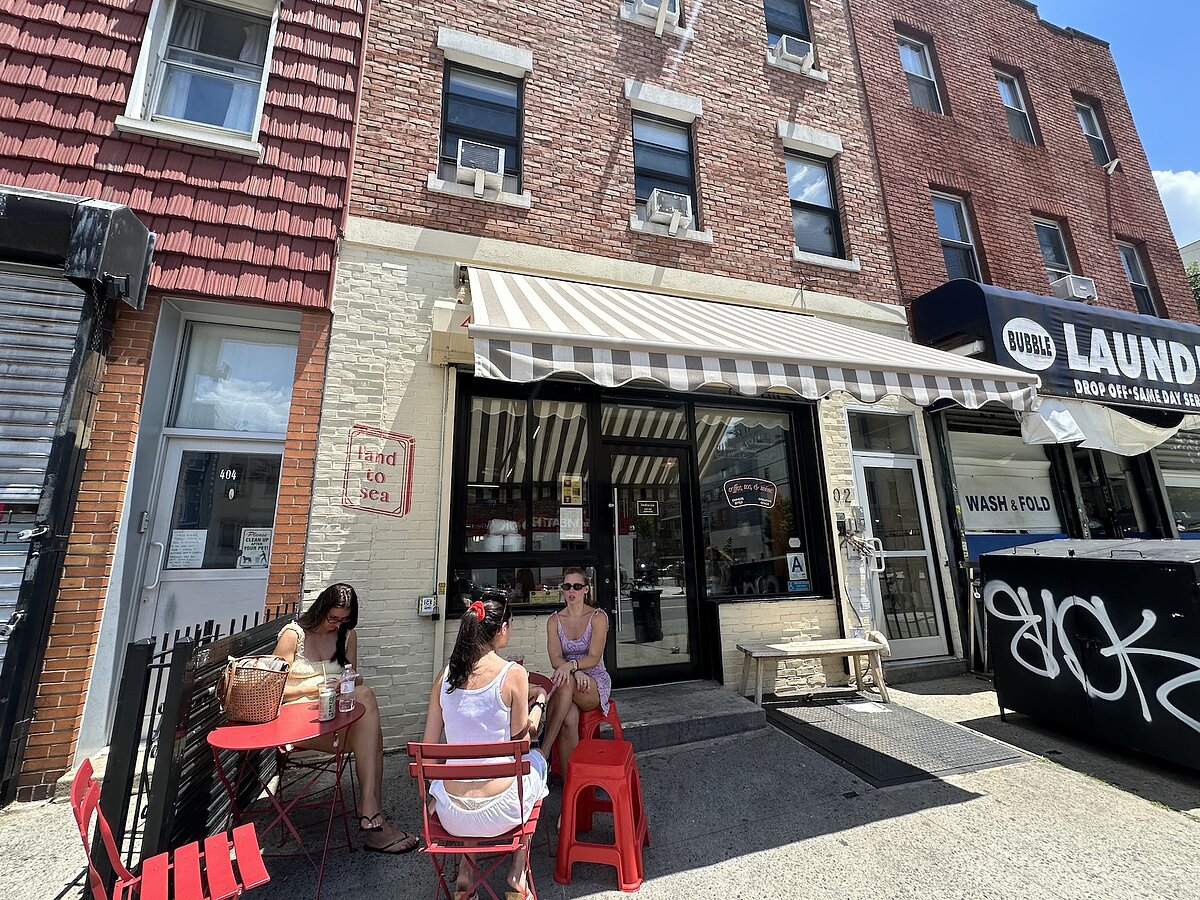
Upon entering Brooklyn’s Land to Sea cafe, you are greeted not only by the aroma of specialty coffee and Chinese pastries, but also by an engaging and insightful multidisciplinary exhibition, “Re-Orienting: asian+american experiences of identity.” Curated by Helene K. Ryu, the group exhibition features eight New York City-based AANHPI artists.
As a former member of Godzilla Asian American Arts Network member in the mid-1990s who saw the birth of Godzookie afterwards in the early 2000s, and then Asianish in 2018, I was curious to learn how Gen Z is exploring Asian American identity through art. Rather than presenting Asian American identity as a search for belonging, “Re-Orienting” succeeds because it portrays identity as a continuous process of self-definition through intimate, deeply personal narratives.
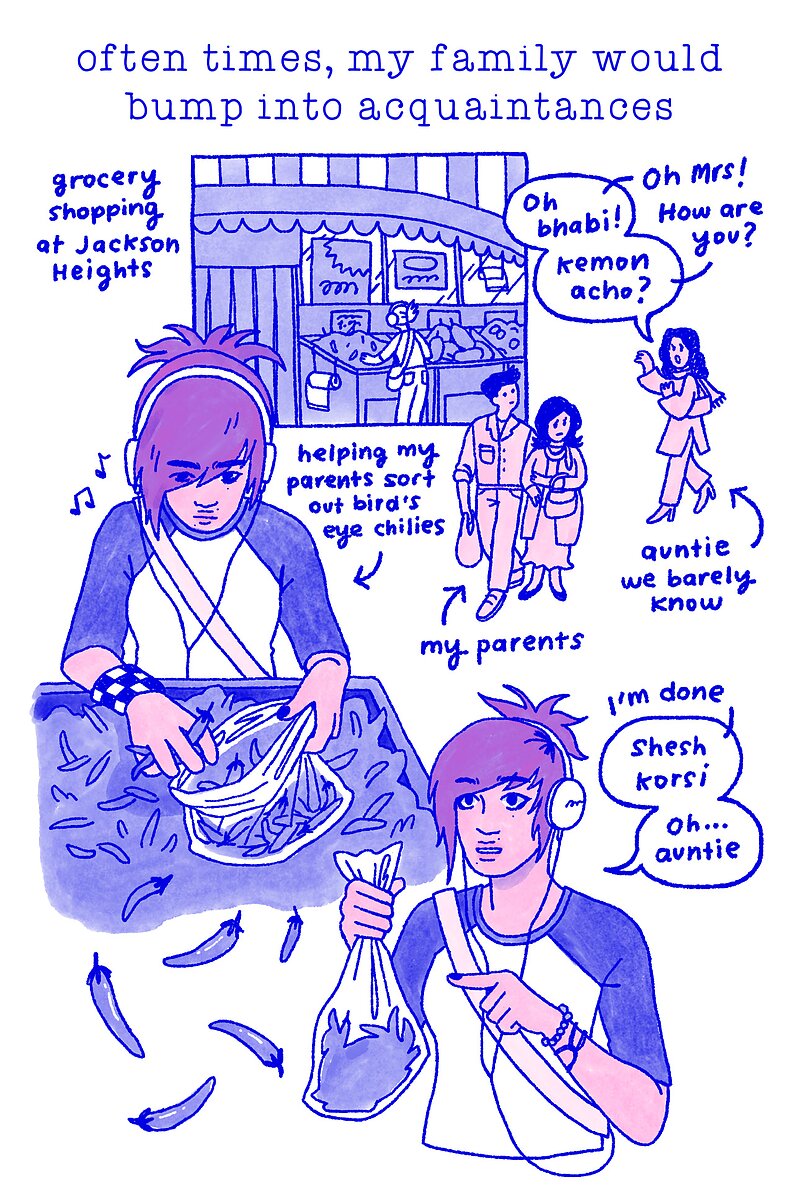
Radia Rahman’s “Ekhane” (2026) is an illustrated comic series which stands out because of its startling use of colors. In the exhibition label, Rahman reveals that “Ekhane” means “here” in Bangla. She affirms her identity by combining the imagery of self-portraits and group representations. Pink and blue tones dominate the images which are supplemented by succinct texts: personal testimonials that reveal her queerness, her family’s poverty during her youth, and her journey to embrace herself as an artist.
Rather than presenting healing as a linear journey, the comic series suggests that identity is continually reconstructed through memory, language, and inherited trauma, echoing the exhibition’s emphasis on internal exploration. Rahman’s decision to pair diary-like reflections with playful imagery prevents the work from becoming didactic. Instead, each panel adds emotional weight, making the series one of the exhibition’s strongest explorations of identity.
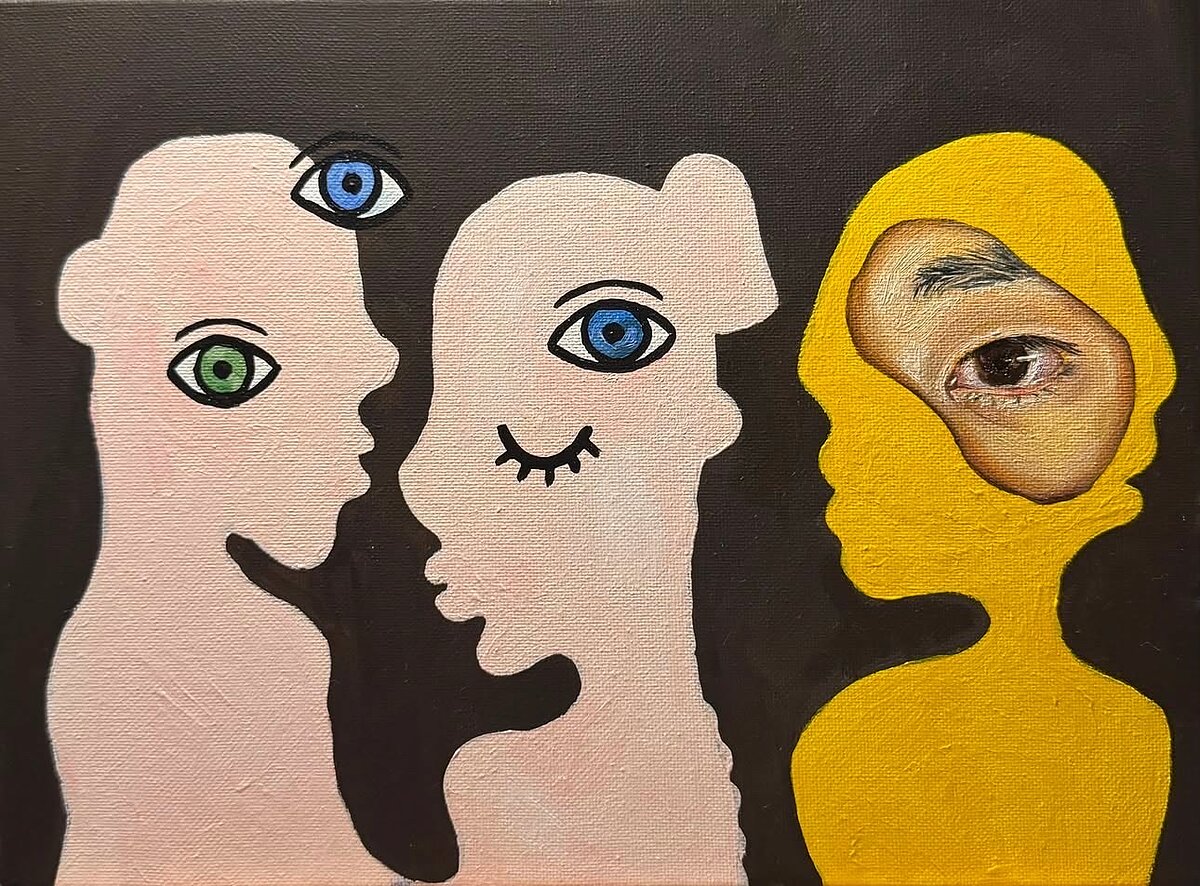
Helene K. Ryu’s paintings also explore identity through the artist’s lived experiences. Ryu’s 7th grade (2025), an intimate oil and acrylic painting, tells a story about stigma and internalized racism. In it, three distorted profiles are painted against a black background. The two blush colored profiles are clearly a pair, and have comic-like displaced blue and green eyes. By contrast, a yellow figure with a naturalistically painted brown eye interrupts the composition like a cutout.
This figure is plainly disconnected from the blush-colored pair. Instead of illustrating adolescent shame, the painting queries the viewer, and asks how cultural identity is performed, perceived, and internalized. Which image do we identify with? The ambiguity of the collage-like composition rewards sustained viewing, transforming what could have been a personal memory into a shared emotional experience.
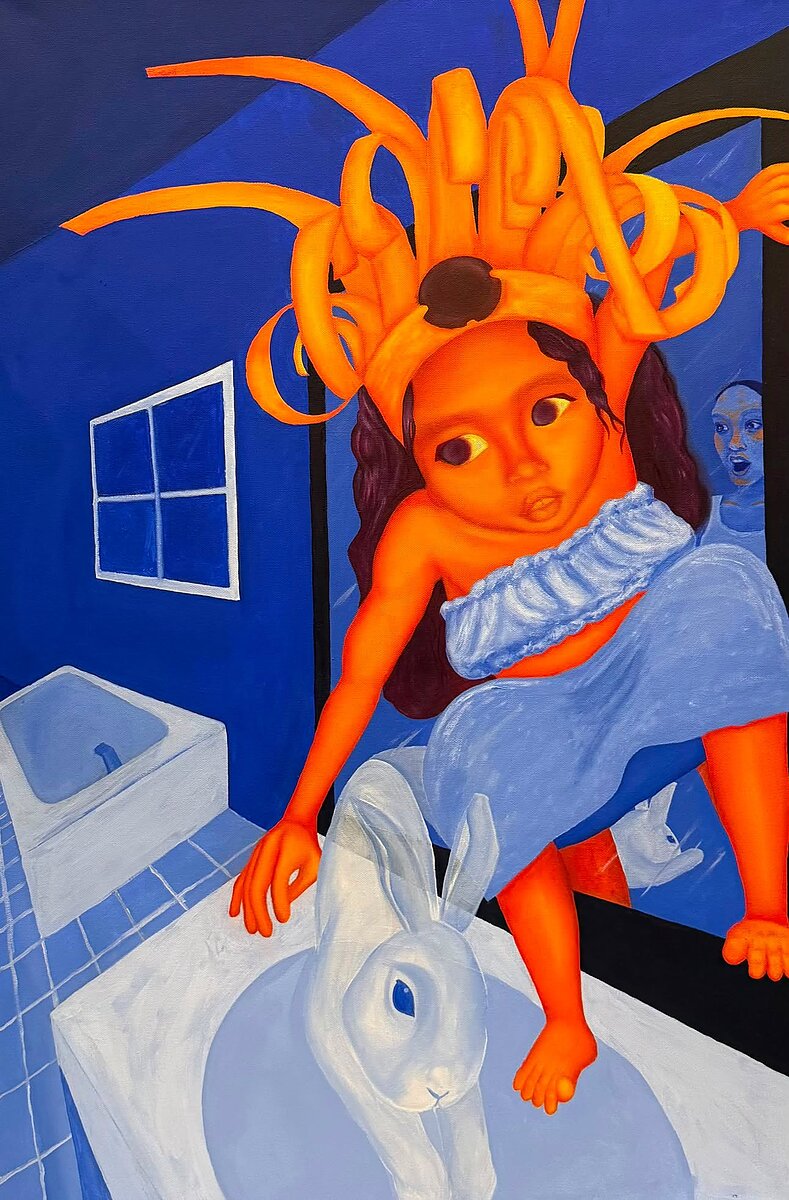
Siena Santos’s striking oil painting, Reflection (2026), depicts identity as something inherited. An animated girl seems to jump out of the painting accompanied by a rabbit. The girl’s escape is confirmed by a woman who appears in the mirrored background with her mouth agape. Santos’ self-portrait as the woman catches her younger self adorned in traditional Chamorro dress.
Santos collapses time and generations through the act of reflection; the tension between indigenous cultural identity and Spanish and American colonization in Guam is implied. The painting’s layered symbolism makes inherited identity feel both personal and collective, strengthening the exhibition’s exploration of how memory shapes belonging. The painting invites viewers to imagine lives interrupted—or never lived—by migration, suggesting that identity is shaped as much by unrealized histories as by lived experience.
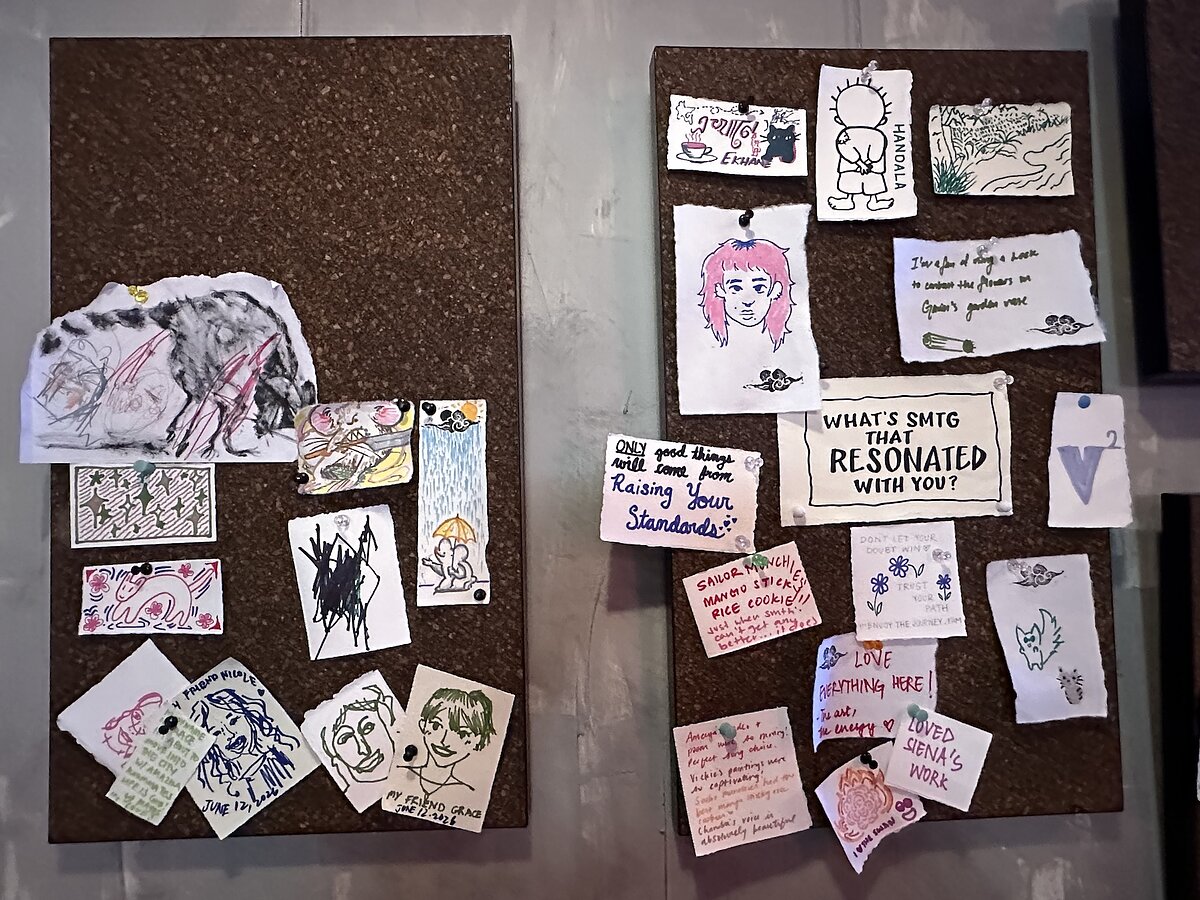
As an extension of the exhibition’s principal theme, an art board invites visitors to share their own experiences navigating identity. The heartfelt comments, whimsical drawings, and personal reflections posted on the board demonstrate that identity continually shifts through dialogue and exchange.
Other participatory elements include QR codes to a digital program, a film and artists’ websites, and tactile acrylic paintings on wood by artist Vickie J. Lin that invite touch. These participatory elements extend the exhibition beyond observation, encouraging visitors to approach identity as something experienced, questioned, and continually reshaped.
In my own experience, earlier generations of Asian American artists often formed their identity as a protest against invisibility and demand for representation. At Land to Sea, these younger artists seem to begin from a different position—they treat identity as an evolving artistic material. Personal history, stigma, inherited trauma, and memory become generative tools and methods rather than burdens that need to be overcome. In “Re-Orienting,” identity is an ongoing practice of remembering, questioning, and becoming.
“Re-Orienting: asian+american experiences of identity” is on view at Land to Sea through August 31, 2026.
—Chanika Svetvilas is an interdisciplinary artist based in Princeton Junction, NJ. Her writing has been published in Disability Studies Quarterly, Wordgathering, and ACES magazine. She has presented her research at the College Art Association Conference, the Society for Disability Studies Annual Conference, Pacific Rim Conference on Disability, and the Inter-Asia Cultural Studies Conference.