Art and Chinamaxxing: Astria Suparak and Techno-Orientalism
In January 2025, millions of American TikTok users facing the potential shutdown of the platform migrated onto Xiaohongshu, a Chinese social media app most had never heard of. Through this app (also known as RedNote), many Americans discovered an inside look into the everyday lives of Chinese netizens, vastly different from the China they knew from headlines and Hollywood as a surveillance state. Within a year, traces of this culture began to seep into the American mainstream—by spring of 2026, “Chinamaxxing” became a viral sensation.
On TikTok and Instagram, young Westerners began drinking hot water each morning, practicing qigong, boiling apples into tea, and captioning it all with the now-ubiquitous line “you met me at a very Chinese time in my life.” Chinese American creators like Sherry Zhu, whose video on drinking hot water has over 5 million views, found themselves cast as guides to becoming a Chinese baddie. White boys squat on street corners chugging bottles of Tsingtao beer. As The New York Times noted, the trend could be considered “an absurdist joke, a wellness goal or an ironic expression of protest–or all of the above.” Chinamaxxing frames Chinese-ness as something that’s consumable: as aesthetic instead of a lived identity.
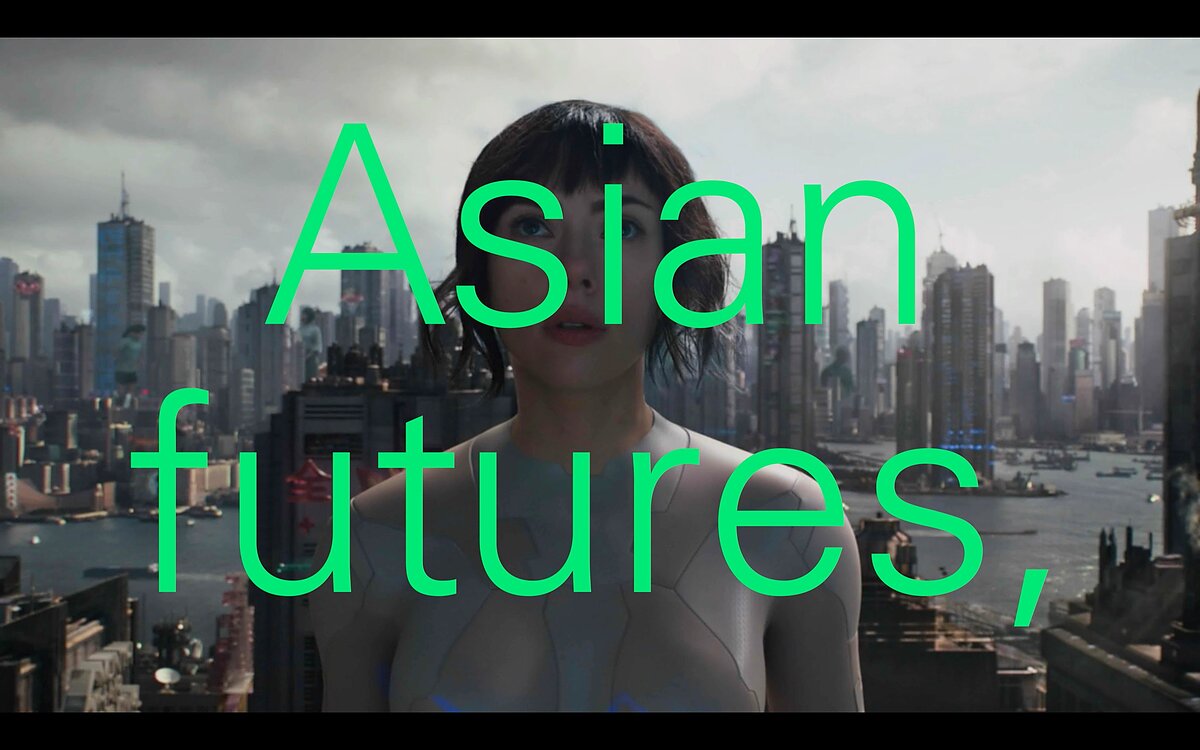
In her ongoing series “Asian Futures,” artist and curator Astria Suparak unpacks this tendency of American media to borrow from Asian culture while simultaneously marginalizing actual Asian people. Among the films she examines is the 1982 dystopian film Blade Runner. While the neon kanji reflected in rain-slicked streets may not appear to have much in common with a non-Chinese college kid cheerfully declaring he’s “in a very Chinese time in his life,” both compel us to consider: Who is the culture for, and who gets to be central to the story it tells?


Set Dressing
What Suparak’s research across over 60 years of mainstream sci-fi shows is that “Asianness” in Hollywood’s imagination of the future gets reduced to atmosphere. A home decorated with Buddha statues. A blonde woman in a cheongsam. Speculative cityscapes punctuated with Arabic signage. These elements are pulled from across Asian histories—art, design, fashion, religion, martial traditions—stripped of their original context and remixed into a generic “Asianness” that can be applied like a filter to any speculative setting. Asian cultures are, as Suparak’s project describes, “mixed and matched, contrasted against, and conflated with each other” into an interchangeable aesthetic resource. The cultures furnish a world that its people don’t get to live in.
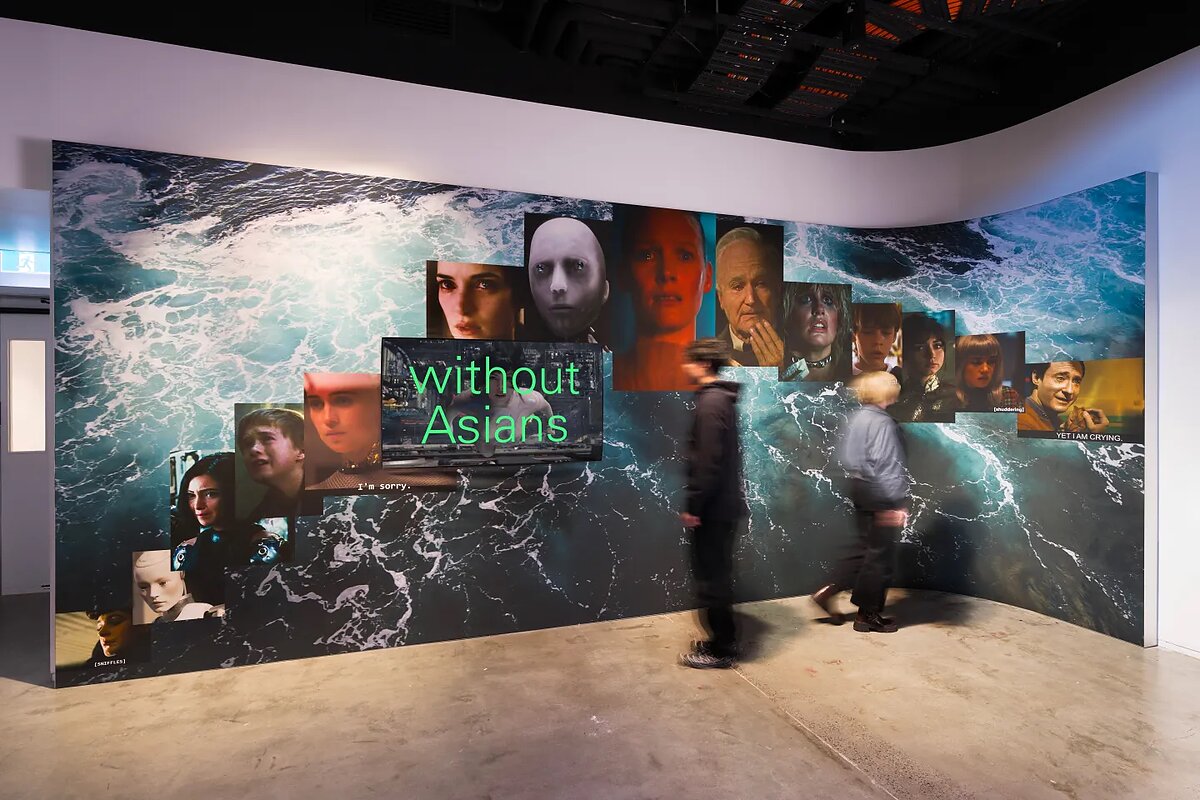
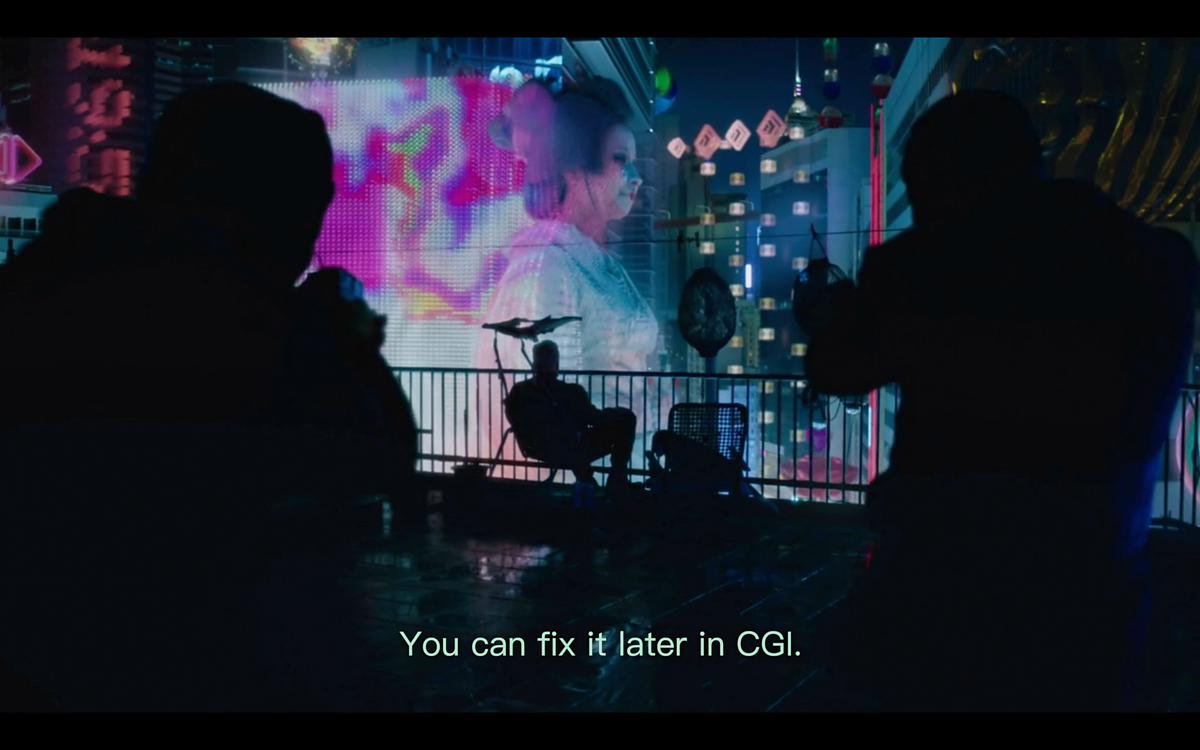
Suparak’s companion installation, White Robot Tears (2024), shows that even the white robots in that world are granted an interiority its Asian people never are. In films like Blade Runner and Ex Machina (2014), sympathetic AI agents weep, love, grieve, and philosophize. The camera lingers on their faces. They get the monologues, the moral dilemmas, and the close-ups that teach an audience to care about their plights. The Asian figures in the same films get none of that; they appear as holographic advertisements, mute virtual geishas, set dressing. As Suparak told The Hollywood Reporter, these robots are “who the audience is supposed to root for,” and “the way they’re presented is in stark contrast to how Asian robots are often dehumanized.” But in many of these films, the comparison isn’t white robots versus Asian robots. It’s white robots versus Asian humans. The machine gets to be a person. The person gets to be scenery.
A Very American Time
In the 1980s, Western anxiety about Japan’s economic and technological surge spilled from trade policy into pop culture. Media theorists David Morley and Kevin Robins named this “techno-orientalism” in their 1995 book Spaces of Identity, and scholars including Toshiya Ueno, Wendy Hui Kyong Chun, and the editors of Techno-Orientalism: Imagining Asia in Speculative Fiction, History, and Media have since expanded on it.
The basic idea is this: In Western pop culture, Asian societies get portrayed simultaneously as super-advanced and less than fully human. Japan and, more recently, China and Korea show up in sci-fi and news media alike as cutting-edge and hyper-efficient, but also cold, robotic, and lacking individual feeling. Morley and Robins described how Japan came to exist in the Western imagination as “the figure of empty and dehumanized technological power”—the people indistinguishable from technology. Zeroing in on individual props and frames, Suparak’s work makes that conflation visible.
Chinamaxxing doesn’t get rid of this framework, though the valence has changed. The old techno-orientalism saw China’s difference as a threat: “they” would outcompete, automate, and replace “us.” Now that same difference is what’s supposed to save us. The young American drinking hot water from a thermos, practicing qigong, downloading Xiaohongshu is running toward Chinese modernity, not away from it. But the underlying structure of projecting your own needs and fantasies onto a simplified version of “the East” hasn’t gone anywhere.
The cultural story that has dominated since the mid-20th century—the promise that American innovation, American entrepreneurialism, American technology would deliver the good life—is failing to convince a generation drowning in student debt, priced out of healthcare, and watching their social media platforms decay in real time. China showed up in their feeds as a place where trains run on time, healthcare is affordable, and people seem to eat together.
But admiration can be just as flattening as fear. In Suparak’s films, Asian culture is consumed as raw material for building fictional worlds. In Chinamaxxing, it’s raw material for building a better version of yourself—specific histories evaporated into wellness content.
The Feed
For decades, most Americans learned about China through the news, government briefings, Hollywood, and the occasional college course. These channels shared a default orientation toward China-as-geopolitical-problem. Even sympathetic coverage (profiles of Chinese entrepreneurs, stories about poverty alleviation) framed China as a rival to be assessed or a developing country to be evaluated against Western benchmarks. “Will China overtake the US?” “What does China’s rise mean for us?” Meanwhile, in popular culture, as Suparak’s work shows, China showed up primarily as exotic backdrops, surveillance states, faceless crowds. Whether it was CNN or Blade Runner, the image was produced for a Western audience, by Western institutions, to serve Western stories.
And then a different China started showing up in the feed. Street vendors making jianbing at dawn, apartment tours in Shenzhen, skincare routines, vlogs about walkable cities and affordable healthcare. Chinese cinema, diaspora networks, and academic exchange had offered access before, but none of them reached millions of ordinary Americans at once, in an interface designed for casual scrolling.
Algorithmic curation shapes this encounter too. Poverty, political repression, labor exploitation, the experiences of marginalized communities within China–none of it is likely to trend. What surfaces is a specific slice of Chinese life that happens to speak to American desires at this particular moment. The feed performs its own version of the operation Suparak identifies in cinema: it selects, strips context, and curates life for consumption. And on the receiving end, those following the Chinamaxxing trend perform that operation again: selecting the practices that appeal, stripping them of context, making them their own.
The Burden
In a conversation on the Many Lumens podcast, filmmaker Maori Karmael Holmes connected Suparak’s work to Greg Tate’s anthology Everything but the Burden, an analysis of how Black culture is endlessly consumed and commodified by white America while Black people themselves remain excluded and endangered. The parallel applies to Chinamaxxing: The Chinamaxxer wants the thermos and the qigong and the communal meals but what gets left behind is the history—political, material, specific—that makes those practices what they are.
Take the hot water habit as an example. It has roots in traditional Chinese medicine’s principles about keeping the body warm, but its ubiquity in modern China was also shaped by 20th-century public health campaigns: Kuomintang-era hygiene movements, the Red Army’s promotion of boiled water during the Yan’an period, and the Patriotic Health Campaign of 1952 that plastered school walls with slogans about drinking boiled water three times a day. That layering is what gets lost when it shows up on TikTok as a wellness hack.
The China being idealized by Chinamaxxers—communal, grounded, less lonely—is also not necessarily the China actually experienced by young Chinese people. As Sixth Tone notes, young Chinese people are increasingly trading hot water for cold brew, energy drinks, and sparkling water. The “Are You Dead Yet?” app that went viral on Chinese social media (users check in daily to confirm they’re still alive) is a darkly funny measure of how isolated many young Chinese people feel. The grueling 996 work schedule (9am to 9pm, six days a week), the pressure-cooker university entrance exams, the housing restrictions that tie your options to where you were born: young Chinese people are memeing about these realities constantly. This isn’t hidden knowledge. The Chinamaxxing frame just tends to select for the appealing and discard the difficult. The practices travel; the histories and contexts that shaped them do not.
The “-maxxing” suffix says a lot. Borrowed from incel and self-improvement subcultures (looksmaxxing, statusmaxxing), it frames identity as an optimization problem. To “Chinamax” is to treat Chinese culture as a stack of upgrades: hot water for gut health, qigong for flexibility, Lao Gan Ma for flavor, collectivism for loneliness.
Chinese netizens have welcomed the trend. Chinese creators are shaping it. The exchange between cultures is real. But I’ve watched it unfold as a Chinese American, and the ambivalence is hard to shake. For those of us who got laughed at for the food we brought to school, or for drinking hot water from a thermos at lunch, watching white peers cheerfully adopt those same habits as lifestyle upgrades produces a feeling I still can’t quite name. As TikTok creator Christina Young put it: “It’s really striking that being Chinese is trendy now, as a couple of years ago, it was a legitimate risk for you on the streets.”
Being Chinese went from dangerous to trendy in two years, and the trend stays right there, at the surface, a few appealing snapshots of a culture with a much longer and more complicated story behind it. I’d love for us not to stop at the post: to make room, somewhere past the trend, for the people who’ve been carrying these practices long before they were content.
—Anna Zhang is an artist and creative technologist whose work explores how we relate to—and can reimagine—technology. Her work has been featured in Real Life, the New Media Caucus, BuzzFeed, and Forbes, and exhibited at venues including the National Museum of American History and Gray Area. She has been recognized by the Judson-Morrissey Excellence in New Media Award and Forbes 30 Under 30, is a member of NEW INC, and writes Negative Space.