Ruoxin Sun: Age of the Captain
Age of the Captain
Ruoxin Sun
Tutu Gallery
June 5–July 31, 2026
Tutu Gallery presents Age of the Captain, the second solo presentation of Ruoxin Sun in New York City, on view June 5 through July 31, 2026. Harnessing steel metal, tin, resin, glass, and found objects to instantiate visual concepts in narrated math problems for young children, this new body of work beckons the discipline again with the artist’s present discernment. Four sculptures based on four classic exercises, one installation resembling a toy set, and a series of small paintings are all themed around elements taken from early math education.
Ruoxin conceived these works from her fascination with reading math word problems as a kid, and the staggering struggle she had with grasping Mathematics Olympiad—an advanced training for Chinese children typically starting at the first year of elementary school. These math problems manifest as concise and well-rounded miniature stories, with characters, plots, actions, and an ending (the answer), close enough to everyday life to be relatable. The stories are meant to teach children problem-solving skills, but in this instance with implications attached. First, the problem solver must instill in themselves an unwavering belief that the one and only correct answer does exist. Then, to understand how and which characters or plots must be reduced into facts. Finally, in which order these optimized information should be applied to form a path to success. On a closer look, these little worlds, with comforting simplicity and predictability, turn unexplainably absurd: there are people running back and forth between point A and B or suddenly changing their direction; some are raising different livestocks in the same coop; others are allocating, with precision and devotion, items that nobody cares about. When the framework fills with reason, the development of these stories slopes into a state of buffoonery.
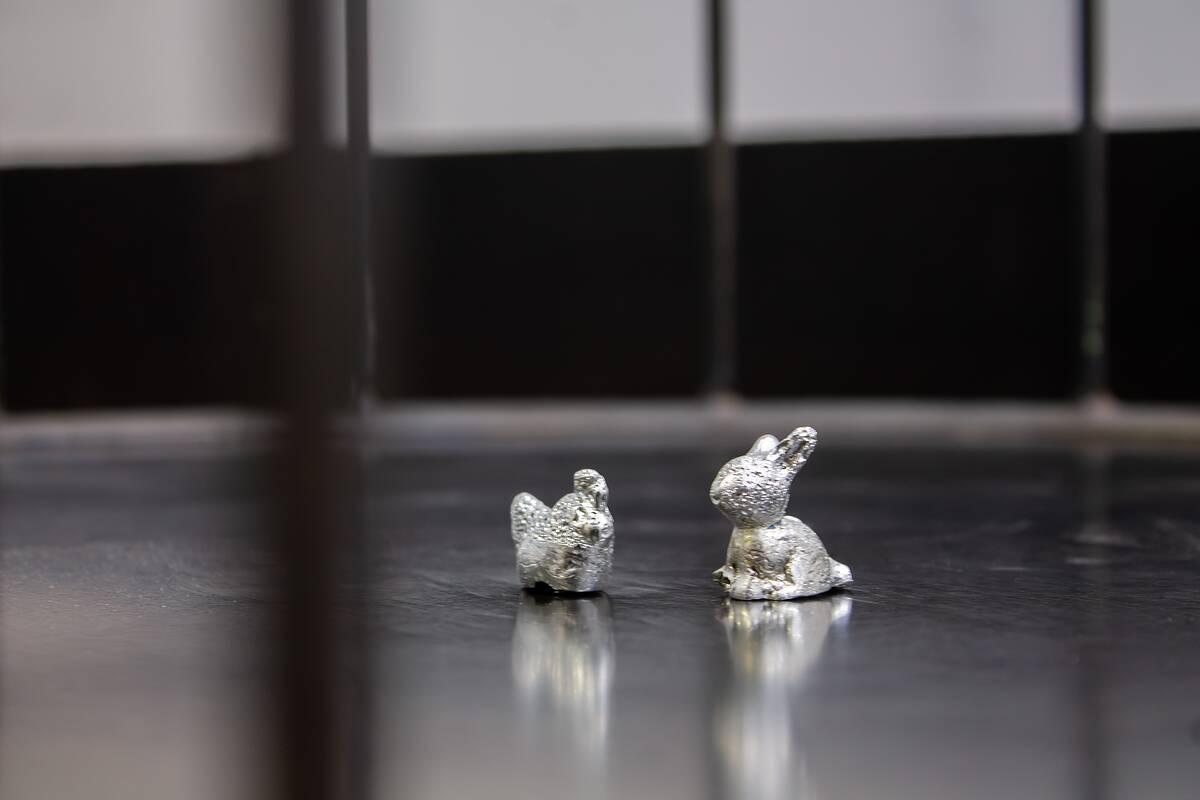
Henny Bunny is a metal sculpture in the shape of a bird cage, with its main structure lifted off from the ground by four MJF (Multi-jet Fusion) printed chicken claws and seven real rabbit feet. The top of this cage is not fully enclosed, where twenty metal rods, each manually sharpened, bent, and polished at the tip, gesturing inward at a single point without touching, as if they are simultaneously confining and letting something escape. The animal legs, described as numbers in the question, no longer belong to an organism yet still stand within the original premises. Embodied as such, the situation remains unsolvable, and the question stays open.
In another work, the mathematical tale takes the form of a metal mesh bag suspended in mid-air by transparent balloons. Driftloooooooooon stems from the type of problems that asks how many balls stay in a bag after several have been taken out, or the probability of a certain colored ball being randomly pulled out from the bunch. The questions convey a commanding confidence as if the initial condition is always properly documented and the final result can always be calculated. However, its visualization almost presents such a bag as a magician’s prop—one can never really know how many balls were inside to begin with, and you can never fully believe what stuff would come out at the end. The bag seems less like a container and more like a lure, capable of producing any answer.
Why are we on the run again? is composed of seven casted tin planks indicating various locations and ways of transportations, based on Ruoxin’s recollection on how she was taught to draw them as a kid, which she later realized is a rather universal style as seen in text books and stock images. These drawings were made into 3D printed tiles as impression molds for sand casting, ultimately solidified into their lasting forms. Between these planks, 3D printed running figures, modeled after the person seen on emergency exit signs, are made into metal look-alikes with silver leaves and steel wool polishing. Blob Bolb calls up another famous scenario where water is depleted and replenished at the same time, with one clear 3D printed resin waterdrop drooping from a wavelike resin block secured to the ceiling, and another ascending back up side by side. In between the two resin waterdrops, a string of glass beads are positioned to indicate the trajectory of the flow, mimicking assistive illustrations used to solve such problems.
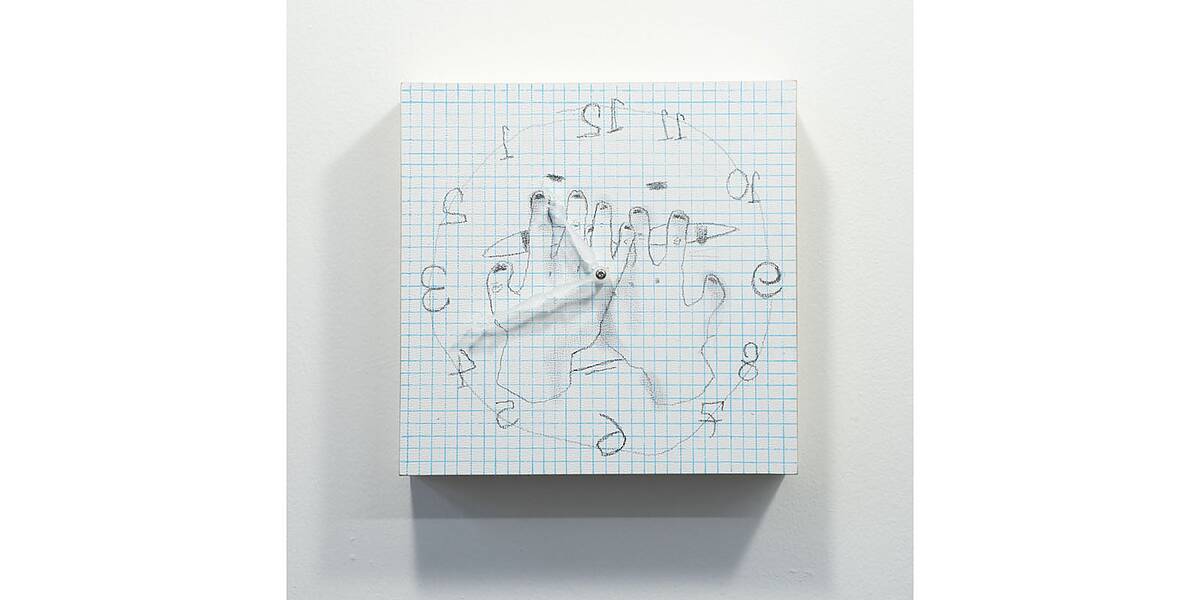
Threading the sculptures between the front and back gallery rooms, a series of small paintings overlaid with laser engraved plexiglass panels extract visual symbols in other works into a slightly flatter format. Ruoxin hand drew blue lines on white gesso over wood panels as a reference to notebooks for school students, then used image transfer or graphite to create the starting imagery, before applying the plexi layer that casts shadows onto it and altering the overall composition. This rather intuitive and loose process leaves room for unforeseen outcomes, at times rendering the content illegible or illusive.
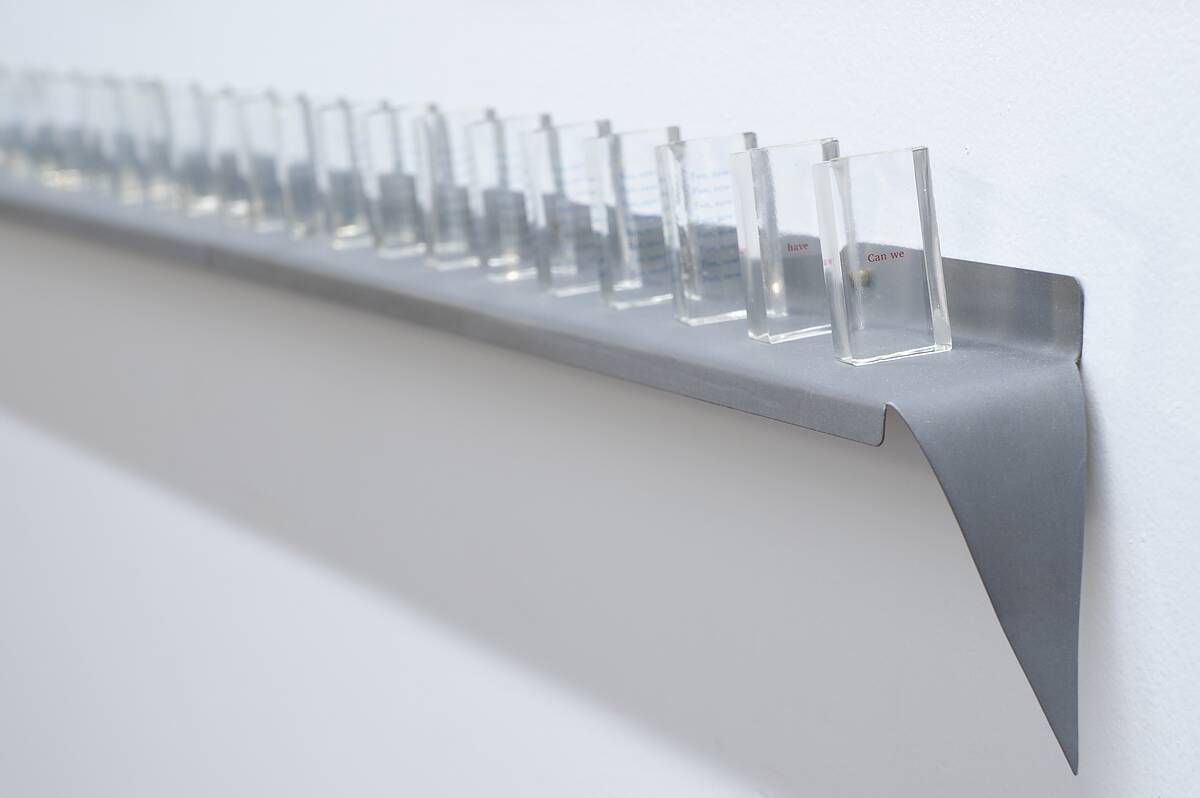
Underneath these paintings, a domino rally lines up on sand blasted steel rails, the end of which are hammered into a flowing shape that extends like a table runner. The domino set displays texts printed on transparent acetate sealed into the center of each block, with the sequence beginning at two blocks with “can we“, and “have”, followed by nearly two hundred compartments with the identical phrase “fun, now?”. Shaped by chocolate molds, each domino came out somewhat tilted, all subtly pointing at the direction that they are supposed to fall towards. Just like the other works in this exhibition, Now Can We Play? returns to the moment when a question is designed for a clear solution, but instead begins to disintegrate under overrecurrence. By actualizing these clues, Ruoxin rebuilds the system that promises clarity but delivers strange effects, where repeating the question is more important than finding an answer.
Ruoxin Sun
Edited by April Z.
April 12, 2026
Ruoxin (Rosina) Sun is a Chinese-born artist based in Brooklyn, NY. Her practice moves between object-making, writing, and digital processes, circling around unstable meanings, broken systems, and unresolved narratives. Often working with translation across media, languages, or memories, she transforms personal and cultural logic into physical forms. Through repetition and fragmentation, she examines how systems behave when they no longer hold. Sun received her BFA from the School of Visual Arts in 2022 and her MFA from New York University in 2024.
Tutu Gallery is a DIY art space located in Bed-Stuy Brooklyn, founded in July 2019 by Tutu (cat) and her human assistant April. Tutu shows art slightly off the wall, in the space, and with interesting people. As of 2026, the gallery has presented 48 exhibitions across the New York metropolitan area, mostly first solo or two-person shows of international emerging artists. The shows and artists here are featured in i-D, ArtReview, Harper’s BAZAAR China, LIFE Magazine China, Brooklyn Rail, Hyperallergic, New York Review of Architecture, and many more.
Contact Tutu Gallery for the address.