Xin Ying on Keeping Martha Graham’s Legacy Alive
As a young classical Chinese dancer, Xin Ying learned to keep smiling—to radiate a touch of sunshine that completes the picture of mirth, grace, and beauty. Eventually, maintaining that smile became a struggle. Holding it while fighting exhaustion felt false and one-dimensional. “At one point I felt I cannot be more pretty or more happy,” she recalls.
In 2008, when Xin was teaching at the Sichuan University of Culture and Arts, a devastating earthquake of magnitude 8.0 struck 80 miles away, claiming over 100,000 lives. The calamity jolted Xin into doing something radically different with her life: She decided to study modern dance at the Martha Graham School, despite knowing nothing about Graham’s style or repertoire. “Not even a little,” she says. “I just knew her name from a dance history class.”
After two years of preparations and with the university’s support, she flew to New York. When her semester of study came to an end, she tried out for Graham 2, Martha Graham’s student company, and was hired as a part-time dancer. The following year, in 2011, she was invited to join the main company—she has never looked back since.
Martha Graham, the mother of modern dance, founded her company in 1926 to break free from the European traditions of ballet and forge a new American expression. Her movement is led by the breath and driven by raw emotion. As a result, the torso is fluid, unstifled by the corset; the feet are bare and free to flex, unbound by pointe shoes.
In Graham’s world, women are presented not as delicate flowers but as full-fleshed humans. Her dances delve into the psyche of mythic female figures like Hecuba, Phaedra, and Clytemnestra, shifting these side characters and their emotional lives to center stage. Xin found freedom in discovering this deeper, messier form of beauty. “Graham is so physical, so real. It’s OK to be ugly, which is very beautiful in its own way,” she explained. “She taught me how to be a woman, how to be an artist.”
Graham was a trailblazer for diversity in dance. The company began as all-female and was the first in America to become racially integrated when Mary Hinkson joined in 1951. A long line of Asian dancers precede Xin, including Yuriko Kikuchi, who came directly from a World War II internment camp in Arizona and started what became Graham 2. When Xin was new to the company, she looked up to seniors like Miki Orihara and Fang-Yi Sheu.


Taking on her dream role
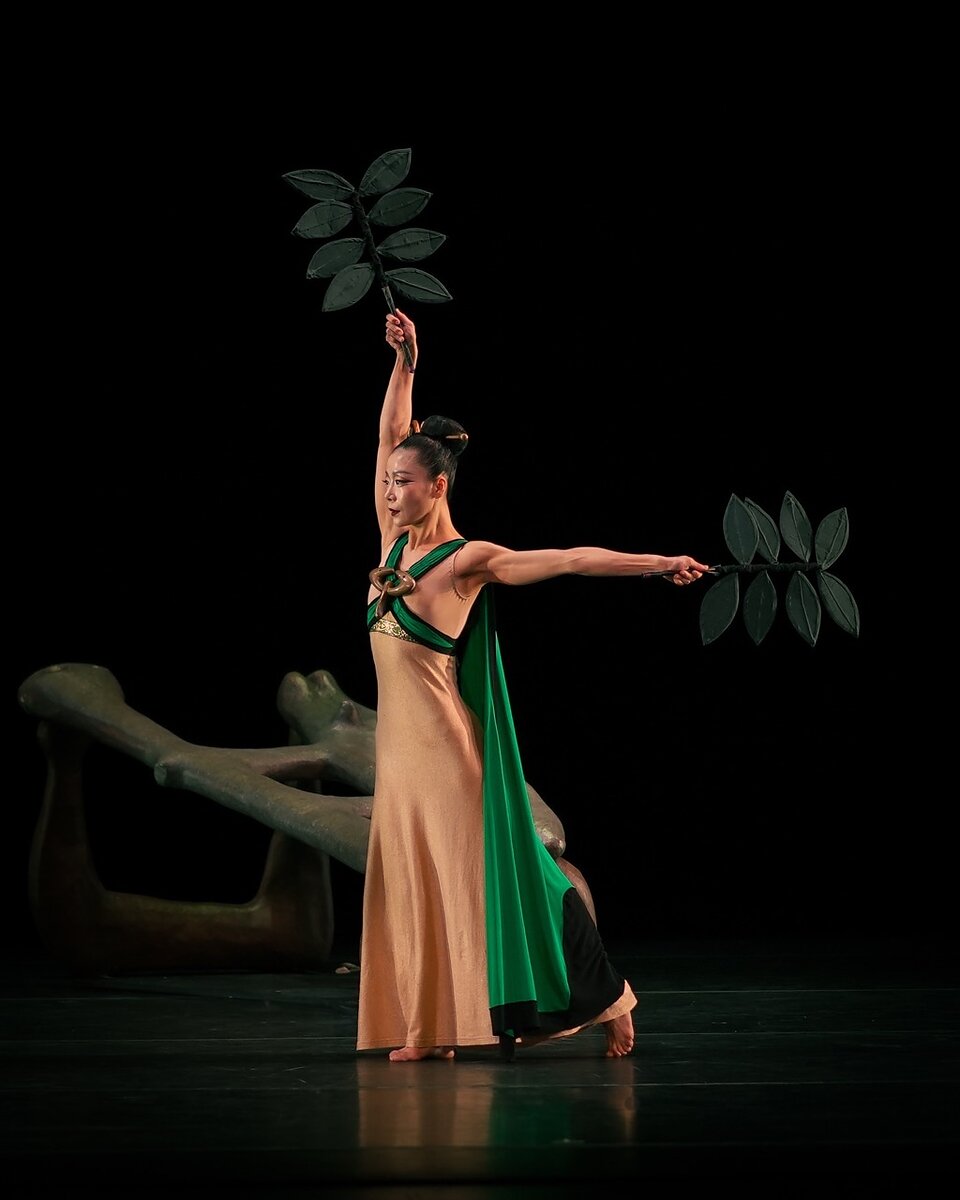
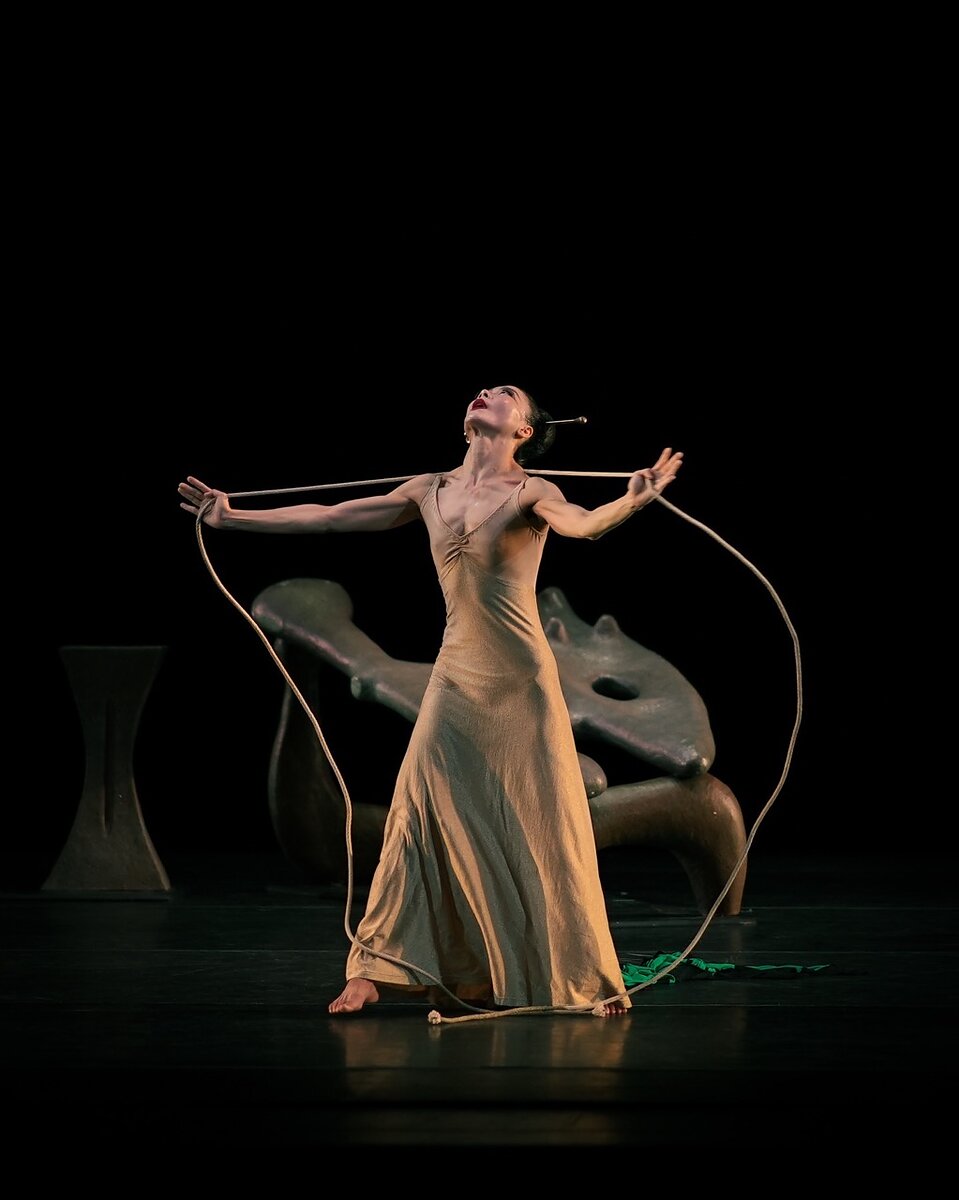
In 2019, artistic director Janet Eilber offered Xin her dream role of Jocasta in Night Journey (1947) in the upcoming season. A retelling of the tragedy of Oedipus from the perspective of his mother Jocasta, whom he unwittingly marries, the piece is set on the night Jocasta grapples with the revelations before she hangs herself. Eilber considers Night Journey to be Graham’s greatest work and the lead role to be among the most complex. “It takes an expert and it takes maturity,” she said. “It takes an artist of the most experience and willingness to excavate their own psyche and feelings.”
But it wasn’t meant to be. Xin found out she was pregnant and had to drop out. Later, the entire season was cancelled because of COVID. Only after another six-year wait, in this past April, did Xin make her debut as Jocasta at New York City Center, part of the momentous Graham100 season, celebrating the centennial of the oldest dance company in America.
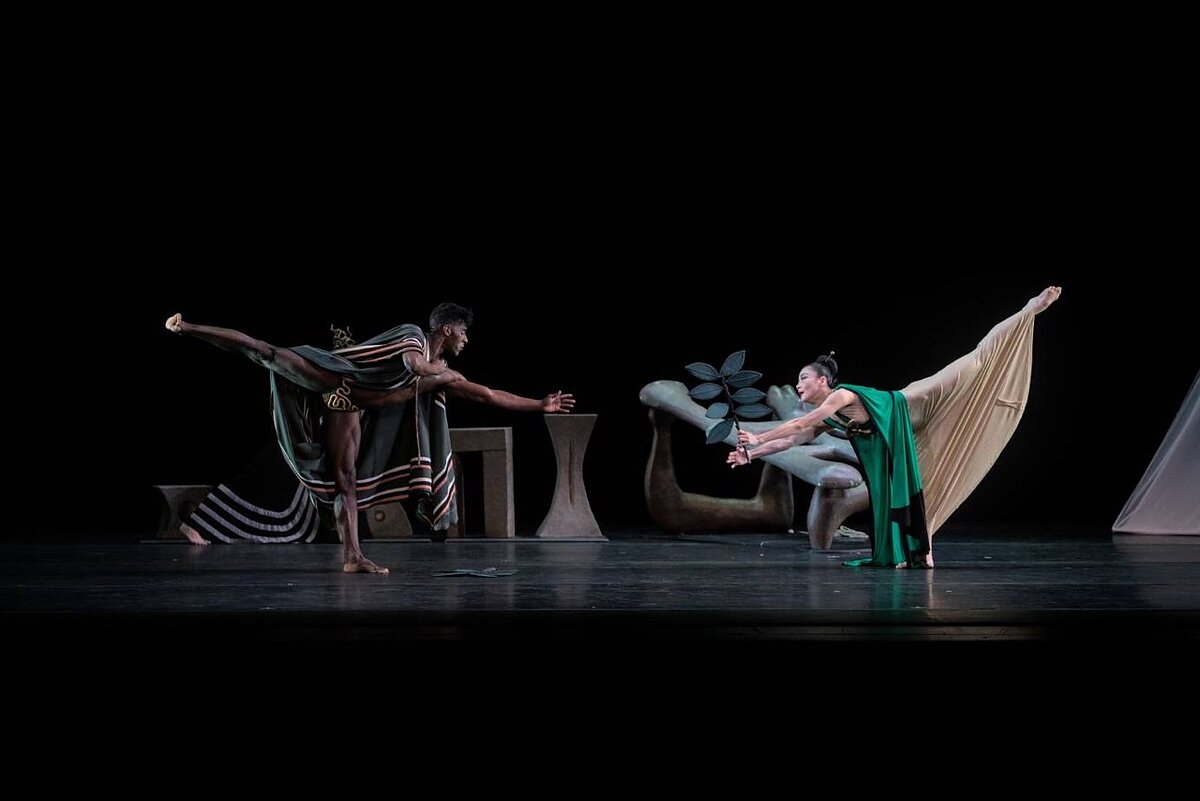
Now that she was a mother and at the peak of her physical fitness and emotional maturity, Xin felt readier than ever to step onto the Isamu Noguchi-designed set and into the costume created by Graham: her hair in a high bun, her sinewy frame hugged by a cream slip and a regal green cloak, fastened by the oversized brooch that Oedipus uses to blind himself. For Xin, the difficulty of the role lay less in the dancing and more in the storytelling. Even at the start of the piece, when Jocasta turns around to face the audience, the dancer has a choice to convey fear, confusion, or anger. “This one moment can have so many different interpretations,” she said.
“Ying has grown into one of the most expressive and powerful artists,” Eilber said. “Her dancing and her emotional intelligence on stage is so specific and so detailed. She’s really at the top of the art form.”
At the Saturday evening performance, over 100 alumni appeared on stage after intermission, arranged by the decade they joined the company. To raucous cheers, they took a bow row by row, starting with the 2010s and ending with the 1960s. Xin was in the wings, preparing for the finale piece, Chronicle (1936). “I was just hiding in one corner, but I feel their presence,” she recalled. After the alumni cleared out, Xin looked at the empty stage that had been “blessed by legends” and thought, “Let’s go.”
Graham remixed by technology
Xin believes an artistic legacy is lost when its guardians cling to the past rigidly as if it were the absolute, unshakable truth. “For a legacy to continue, you need to know how to communicate in a new way,” she said. Consequently, she has been experimenting with technology like AI to reimagine Martha Graham’s pieces and make her archive accessible to new audiences. While some might decry such approaches as dehumanizing, Xin sees technology as a tool that can co-exist creatively with the body in making art.
In 2018, during a Graham residency with Google, Xin had dancers wield VR brushes to paint a 3D environment. For her MFA thesis at New York University last year, she used AI face-swapping to ponder the relationship between the world-famous Graham and the 400 often-nameless dancers who have passed through the company’s doors.
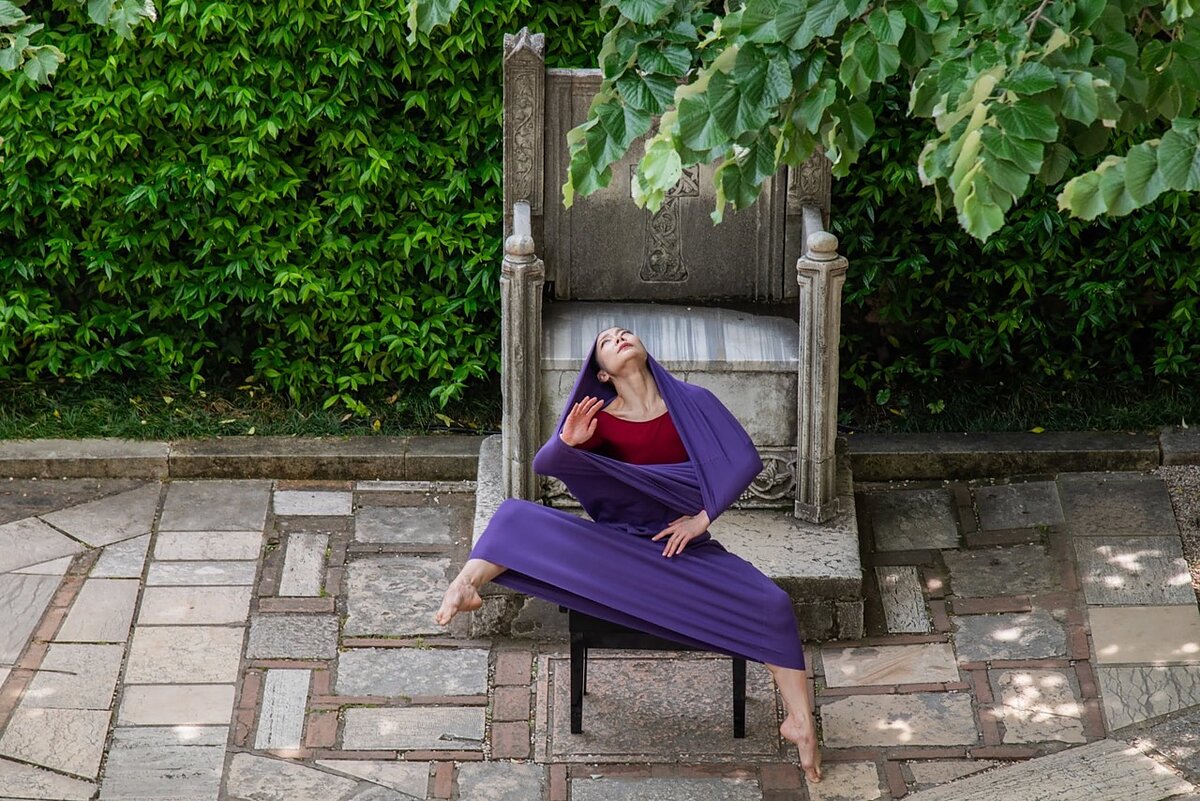
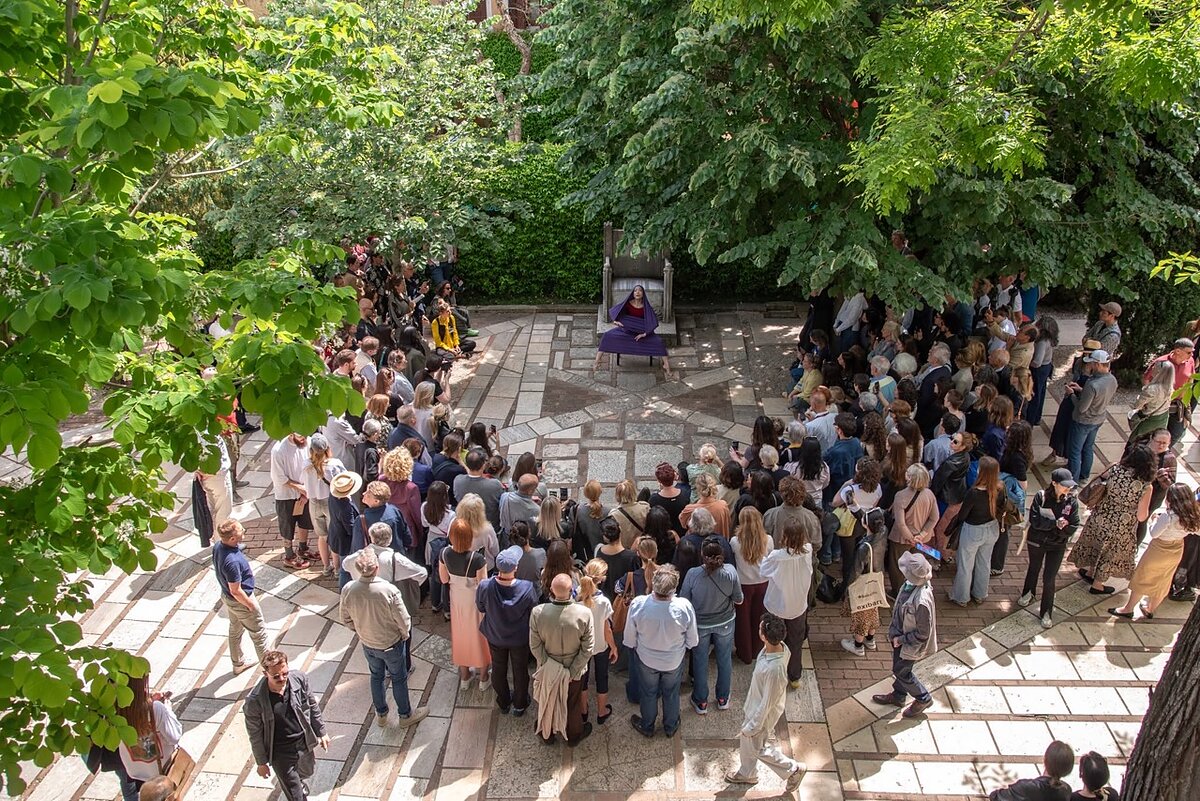
Two weeks after the City Center shows, and a week before the company flew to Italy, Xin staged a new work, In the Folds of Her Purple (2026), at the Guggenheim. Presented by the nonprofit Works & Process, the triptych of short pieces was inspired by Graham’s seminal solo piece Lamentation and incorporates AI-driven media projections designed by Alan Winslow, David Wallace Haskins and Timothy Kelly.
Since its premiere at Maxine Elliott’s Theatre on West 39th Street in 1930, Lamentation has become an iconic work seared into the collective cultural memory, referenced in everything from Peter Lindbergh’s 1994 photoshoot of Madonna to the Be Our Guest sequence in the 2017 live-action version of Beauty and the Beast.
The original four-minute piece featured Graham as the personification of grief, seated on a bench and encased in an elastic purple tube of jersey—a sort of modernist sackcloth. In her new work, Xin pushes past the iconography and draws out the visceral struggle of the body within. “Today we’re not going to see the tube,” Xin said during an onstage conversation at the Guggenheim. “If you’re coming for that, I’m sorry.” The audience chuckled.
The first segment stars none other than Eilber, who retired from dancing in the ‘80s. It is a rendition of Graham’s original piece, without the encasing fabric but backed by trippy black-and-white live projections of Eilber that lurch and nest into infinity. Before taking the stage, she poses a question to MarthaBot, a large language model that Xin devised and trained on Graham’s spoken and written archive as well as her dancers’ recollections.“
“Do we have your permission to show you a variation of your Lamentation?” Eilber asks. After buffering for some time, MarthaBot replies in a slow drawl: “Lamentation is not a fixed thing… To remix it is not to diminish it. It is to honor it, to let it live again. Let it be remixed, reimagined, reborn. Let it speak in ways I might never have imagined. Let it be yours.”

In between pieces, Xin describes her process, dressed for the evening in a one-shoulder black lamé gown, her long hair pulled back into a ponytail. She constantly thanks her collaborators, including Eilber, quipping that she only got this far because “Janet just says yes to all my ideas.” Between family, personal projects, and the Graham100 tour, Xin is juggling a lot, yet she gives the impression that no hiccup or hectic schedule will ever dim her cheer and compassion.
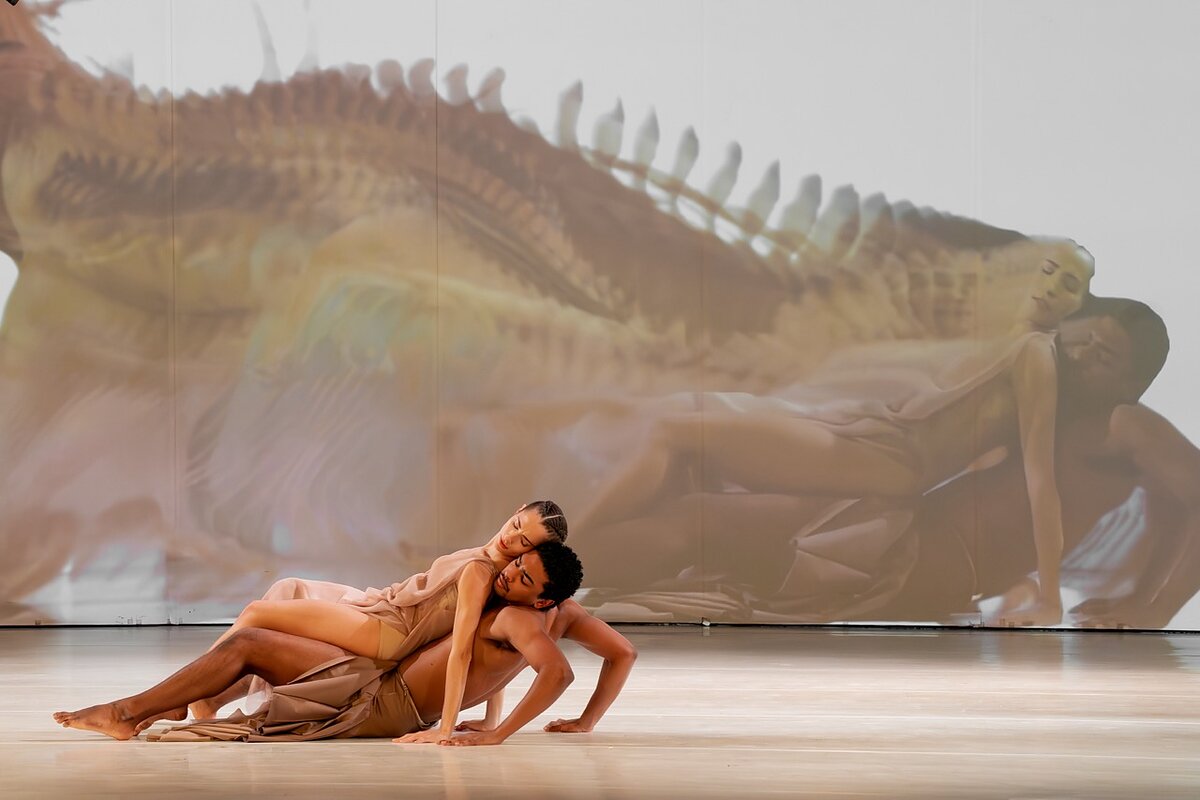
The remaining segments showcase new choreography by Xin performed by company dancers. One is a solo by fellow veteran and “dance hubby” Lloyd Knight that expresses the physical exertions of Lamentation. It is paired with prerecorded volumetric video that used 22 cameras to capture Knight in three dimensions. (Xin first explored the technique in an interactive installation at the Jacob’s Pillow Dance Festival in Massachusetts.) The final piece, a lyrical duet between Amanda Moreira and Jai Perez, interacts with three cameras along the perimeter of the stage.
Xin, who has unceremoniously plopped down on a set of steps toward the back of the audience, observes the performance intently as she toggles between the cameras using a phone app. Filtered through an AI program, images of the dancers in their flesh-colored costumes appear on the backdrop as trails and smudges, like lingering echoes of the past, like traces of wounds that don’t heal with time.
Born to be original
Xin Ying takes pride in her name (辛颖), which is a perfect homophone of the term for “fresh” or “original” (新颖). “It kind of gives you the feeling of: It’s OK to be different,” she said. Although she goes by Ying among friends in America, two-character Chinese names are typically left intact and said in full. And so when her name was inverted as per Western convention to become Ying Xin, she found it disorienting and unrecognizable. At one point, she asked the company to switch the order back and keep it that way.
Perhaps what Xin’s work demonstrates is that, in honoring the legacy of a giant like Martha Graham, there remains room for individuality and personal artistry. “I want the dancers in my company not to be like me,” Graham herself once said. “I don’t believe in having stereotyped me’s running around. They should bear the mark of my work while feeling free to be the individuals they are.”
During a rehearsal at Onassis ONX—a studio in Lower Manhattan that supports the melding of art and technology—Xin was ironing out the kinks of the duet with Moreira and Perez. Near the end of the piece, there is a moment where Perez repeatedly breaks up an exhale into three staccato portions, like jagged sobs. He asks if he should keep strictly to the three broken breaths or if he has the “artistic liberty” to do what feels right.
“You have artistic liberty,” Xin replies without missing a beat. “You are the artist.”
—Fred Voon is an arts writer from Singapore who has contributed features and criticism to the Observer, MILIEU, IMPULSE, Plural, Art & Antiques, and The Art Newspaper.