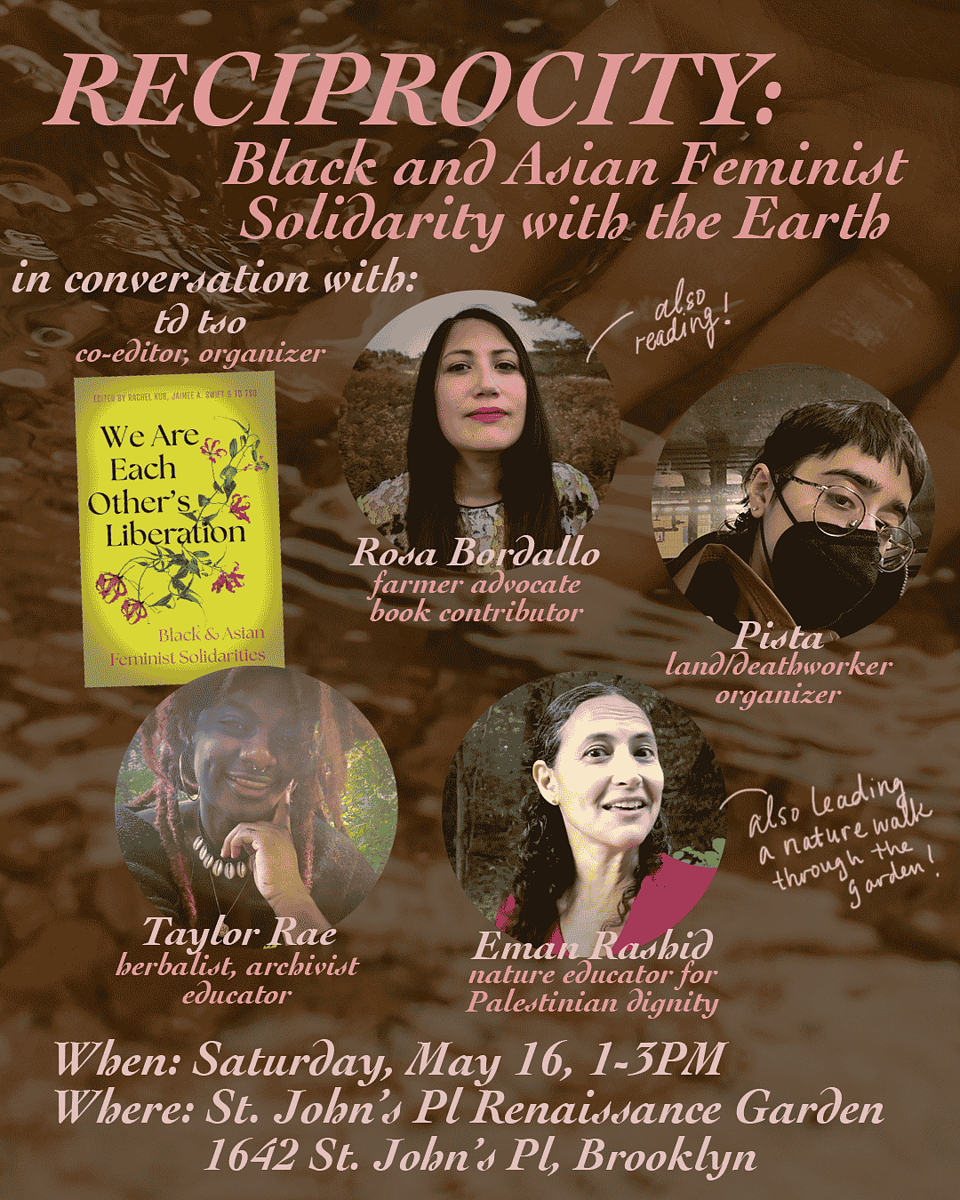
Reciprocity: Black and Asian Feminist Solidarity with the Earth
1 – 3PM
Reciprocity: Black and Asian Feminist Solidarity with the Earth will create a space dedicated to illuminating, unpacking, and strengthening understandings of cross-racial feminist connections as a tool for environmental and food justice. You will explore hands-on practices and healing modalities, from gardening and composting to mutual aid and herbalism, with contributors of the anthology We Are Each Other’s Liberation: Black and Asian Feminist Solidarities (Haymarket Books, 2025) and other practitioners in these spaces in order to facilitate deeper engagement within these intersections. The program will include a reading from the book, panel discussion, and nature walk.
This event is free and open to the public.
Speakers include:
Rosa Bordallo is a farmer advocate, musician, and native of Guåhan in the Mariånas. She currently resides in upstate NY on unceded land of the Oneida and Kanienʼkehá꞉ka peoples. Rosa credits her Chamorro upbringing for her commitment to political and cultural agitation and to Indigenous sovereignty and decolonial futures. Her essay, “The Breadfruit Does Not Fall Far from the Tree” appears in the anthology, We Are Each Other’s Liberation: Black and Asian Feminist Solidarities (Haymarket Books). She has released several albums and EPs as a solo artist and previously wrote and performed music as her alter ego, Manett.
Eman Rashid is a Palestinian-American educator who teaches about Native American and endangered plants and wildlife. She’s also a media consultant with 10+ years in press rooms. A West Bank Native, Eman now organizes across the nation for Palestinian dignity through Indigenous land stewardship, education and activism across generations.
Taylor Rae of Raeflower Holistics is an herbalist, archivist, and clayworker who is passionate about rekindling the land relationships of herself and her communities. After earning a B.A in Environmental Science from Northwestern University with a research concentration in pollination biology, Taylor craved connection with land that cracked open the restrictive parameters set by western academia and offered space for reciprocity, remembering, and collaboration. Through her land practices, Taylor aims to tell the stories of her lineage, create safety in holistic care spaces, combat the oppressive structures, and support community in finding respite in the land once again.
Pista (any pronouns) is a queer South Asian herbalist, educator and organizer currently based on occupied Lenapehoking land in so-called Queens, NY. After many years of working in the tech industry, Pista began composting at the start of the pandemic to re-center mutuality & living connections. Pista works now to compost systems, beliefs & ideas that no longer serve communities in order to rebirth futures of greater reciprocity and care through connecting ancestral Earthwork with abolition.
This event is hosted by late-bloomer.info, a community gardener, cultural organizer, and co-editor of the anthology We Are Each Other’s Liberation. There will be a limited number of copies of the anthology available for sliding scale donation ($10-25 suggested).
Accessibility Notes:
This event is being held at an outdoor community space with uneven grounds that are not easily traversable with wheelchairs or other walking devices. There no on-site bathroom, and the nearest publicly accessible restroom is at a grocery store on the corner. Please plan accordingly and practice recommended public health measures including masking (especially those with respiratory or immune issues), testing negative pre-event, and staying home if you feel unwell or have symptoms.
This project is a part of the What Can We Do? artist grant program, presented by Asian American Arts Alliance (A4) and is supported by public funds from the New York City Department of Cultural Affairs in partnership with the City Council. Special thanks to Council Members Christopher Marte and Sandra Ung. Programs serving cross-cultural solidarity and the Palestinian community are funded through a grant from the Ford Foundation for Social Justice.