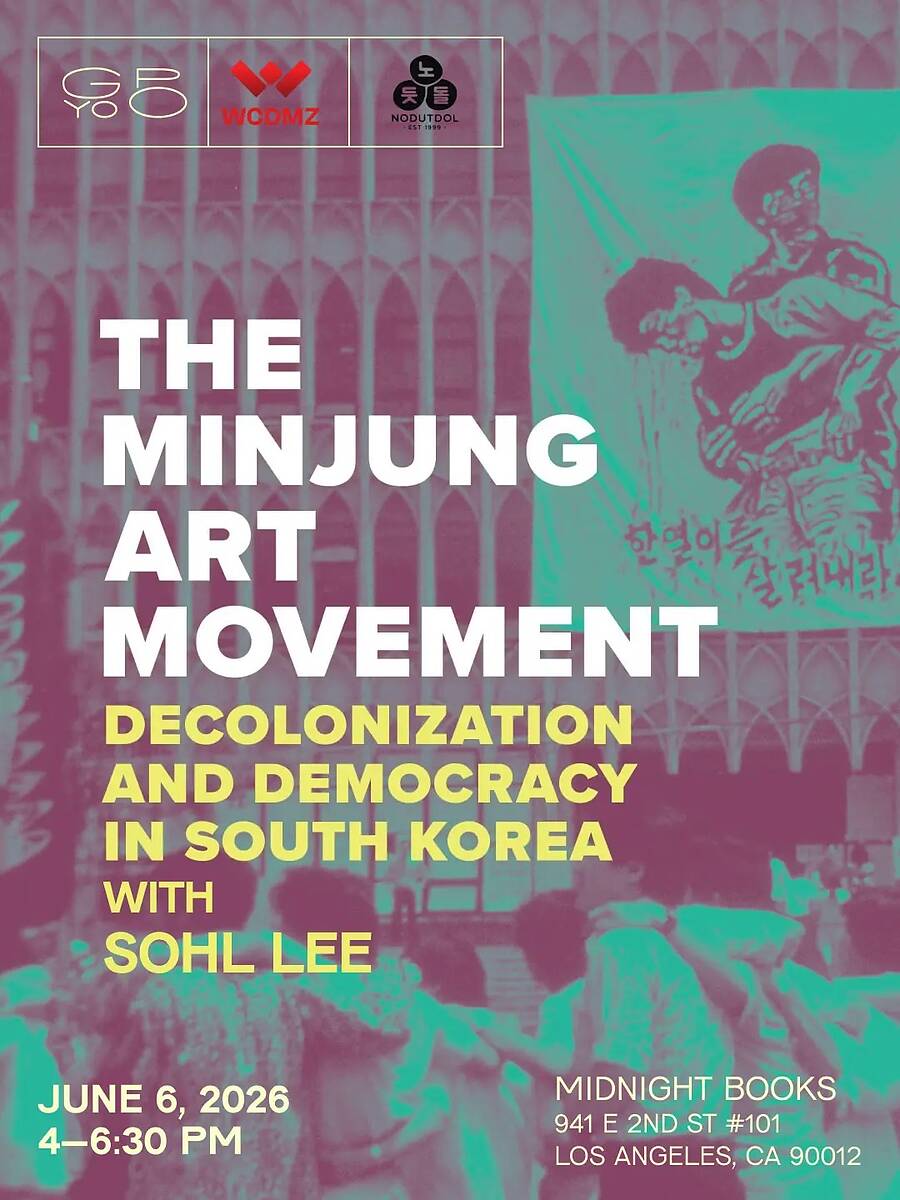
THE MINJUNG ART MOVEMENT: DECOLONIZATION AND DEMOCRACY IN SOUTH KOREA with Sohl Lee
4 – 6:30PM
Join author Sohl Lee at Midnight Books for a special presentation on her recent publication The Minjung Art Movement: Decolonization and Democracy in South Korea.
In the 1970s and 1980s, a striking form of activist art emerged in South Korea during the mass pro-democracy struggles that culminated in the establishment of direct presidential elections in 1987. Known as the minjung (people’s) art movement (minjung misul undong), this multifaceted cultural activism defined the visual language of dissent under conditions shaped by authoritarian rule and the global Cold War. Drawing on Sohl Lee’s recent book—the first comprehensive art historical study devoted to the artists and collectives of the movement—this talk argues that minjung art articulated what Lee calls the conjoined aspirations of decolonization and democracy. Hundreds of artists mobilized printmaking, murals, performance, and image circulation to build what she describe as movement publics, reimagining sovereignty not as a constitutional endpoint but as an ongoing collective practice.
Tracing the genealogy of these aspirations back to the late 1960s, the lecture examines key discursive concepts such as hyŏnsil (“reality”), hyŏnjang (“a site under transformation”), and hyŏnjang misul (“site-contingent art”). It also analyzes how artists critically reinterpreted precolonial visual traditions while mounting decolonial critiques of Cold War modernism. By recuperating overlooked protest aesthetics and performance-oriented practices, the talk shows that South Korea’s democratic transition—and its subsequent rise as a global cultural force—cannot be understood apart from this political and popular art movement. Minjung art ultimately expands the meaning of liberal democracy and offers an alternative genealogy for global contemporary art.